Introduction
Death Valley remains one of the most evocative landscapes in the American Southwest, within this parched terrain, Ed Earl Repp set his 1929 piece, “The Radium Pool,” a work that captures the “lost world” obsession of the era. He offers a vivid, high-stakes exploration of a hidden world tucked away within the salt flats of the Mojave.
Plot Summary of "The Radium Pool"
A newspaper reporter is despatched to Death Valley to cover Professor Bloch’s archaeological expedition. During the journey, the team rescues a delirious prospector who shares an incredible tale regarding his partner, “Driftin’” Sands, a mysterious radium pool on the Manalava Plain, and strange seven-foot creatures with frog-like faces. This account involves a forty-year search for a lost sweetheart, bizarre rejuvenating effects, and capture by alien beings living beneath the most inhospitable landscape in the region.
A Story About Radium
Repp constructs a nested narrative—a story within a story within a story—that creates multiple layers of unreliability. Although the prospector is rescued half-dead from the desert with a mind potentially affected by heat, his glowing green skin provides some evidence for these incredible claims.
The plot operates as pulp archaeology fiction, tapping into 1920s interest in lost civilisations and desert mysteries. Repp transforms the landscape into a gateway to the unknown, suggesting that extreme environments might harbour secrets as alien as another planet. In this sense, the Manalava Plain functions as an American equivalent to the terrestrial otherworlds found in the works of Burroughs or Lovecraft.
Furthermore, the radium pool itself represents peak 1920s atomic age optimism. Discovered in 1898, radium was still viewed as magical in 1929 and used in everything from watch dials to beauty products. Marie Curie had demonstrated its power, but the inherent dangers were not yet fully understood. As a result, the prospector’s glowing skin reflects the tragic phosphorescence of the radium dial painters, though Repp treats it as an enhancement rather than a slow death. These creatures seem adapted to a radioactive environment, perhaps serving as ancient humans mutated by long exposure.
Death Valley Lore
The story belongs to the “lost world” genre of adventure fiction, much like King Solomon’s Mines or The Lost World. Repp simply transplants the traditional African or South American setting to the American Southwest.
In addition, “The Radium Pool” captures the 1920s mythology of the area. The valley had only just become accessible to casual visitors via motor car. Before that time, it represented the ultimate frontier horror—a place where wagon trains vanished and heat could kill in hours.
Specific landmarks and history ground the tale in an authentic geography. The Panamint Mining Company actually operated there, and the Funeral Mountains frame the valley just as described. Beyond that, the narrative references the real-life obsession of prospectors who spent decades searching for lost mines. Repp’s story rose during a transitional moment when the valley was being exploited for industrial gain and romanticised as a myth.
Author: Ed Earl Repp
Ed Earl Repp wrote prolifically for the pulps across multiple genres, including westerns and detective stories. He maintained a long career, publishing well into the 1960s, though “The Radium Pool” represents his early science fiction work. On top of that, his background in pulp fiction shows in the breathless pacing. He piles wonder upon wonder without ever pausing for a logical explanation.
My Thoughts
I admire Repp’s sheer audacity in combining so many impossible elements. Most writers would be satisfied with either the radium pool or the frog-men, yet Repp provides both, alongside phantom wagons and carnivorous cacti. To some extent, he operates on the principle that more wonder is always better. This creates a fever-dream quality appropriate to the parched setting.
Sands has searched forty years for a woman he knew briefly in his youth. Such persistence borders on insanity, yet the author treats the quest with sympathy. At the same time, the prose style perfectly suits the narrator. The prospector tells his story with a compulsive, hypnotic rhythm.
Wrapping Up
“The Radium Pool” offers pure pulp entertainment that delivers exactly what readers in 1929 desired: exotic locations and scientific wonders. Within twenty years, atomic bombs would transform radioactivity from a miracle into a menace. In short, Repp’s optimistic vision represents a pre-Hiroshima innocence that would soon disappear from the genre.
Other stories from Science Wonder Stories
Another vintage pulp magazine:
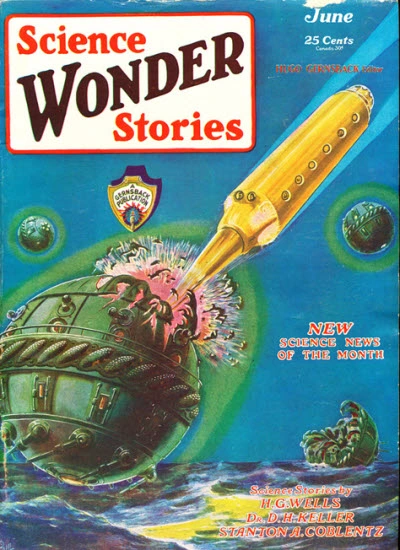
Science Wonder Stories, Vol. 1, No. 2
Astounding Stories of Super-Science, Vol. 1, No. 1
Original Science Wonder Stories issue at the Internet Archive.
Disclaimer: The story featured on this page is in the public domain. However, the original authorship, magazine credits, and any associated illustrations remain the property of their respective creators, illustrators and publishers. This material is provided for informational and educational purposes only and may not be used for commercial sale.