The Diamond Maker by H.G. Wells
4 min read | Free PDF Included

Title: The Diamond Maker
Author: H.G. Wells
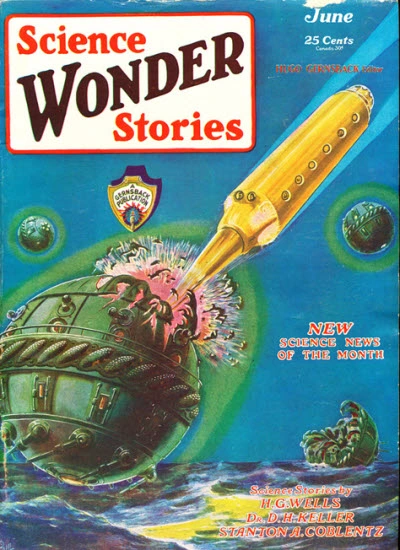
Original Publication: Science Wonder Stories (Vol. 01, No. 1)
Release Date: June 1929
Publisher / Editor: Hugo Gernsback (Stellar Publishing Corporation)
Illustration: Art is not credited
Genre / Subgenres: Pulp Science Fiction
Copyright Status: Public Domain (Free Download Available)
Format & Availability: Article Review + Complete PDF Edition
The complete text of “The Diamond Maker” and its free PDF version are available at the bottom of this article. Click here to skip to the download section.
First appearing in the Pall Mall Budget in 1894, “The Diamond Maker” is an great piece of H. G. Wells’s early short fiction. The text serves as a brilliant character study regarding the intersection of wealth, credibility, and the British class system. As a result, we are left to contemplate whether a revolutionary discovery can ever truly exist outside the bounds of social respectability.
Plot Summary of "The Diamond Maker"
On a quiet evening along the Thames Embankment, a well-dressed narrator encounters a shabby, desperate stranger who makes an extraordinary claim: he has discovered the secret of manufacturing diamonds. The ragged man produces what appears to be a genuine diamond the size of a thumb and offers to sell it for a hundred pounds. Through their conversation, the stranger reveals his tragic story of scientific obsession, financial ruin, and social isolation.
Spoilers Ahead!!!
An Unreliable Diamond Maker
“The Diamond Maker” exemplifies Wells’s mastery of the short story form and his fascination with the intersection of science and human ambition. Unlike his more famous scientific romances about time machines or invisible men, this story operates on a smaller, more intimate scale. In spite of this, it explores equally deep questions about opportunity and the cost of obsession.
The stranger’s obsession with secrecy reveals the dark side of scientific ambition. He cannot publish his results, collaborate with other researchers, or verify his success through the normal channels of scientific discourse because doing so would destroy his potential monopoly. This isolation transforms scientific discovery from a communal achievement into a lonely burden.
Wells traces the descent from laboratory to unfurnished flat, from teaching to selling newspapers to holding horses to begging. Each stage represents a sacrifice to the obsession, yet these sacrifices prevent the very success he seeks. By the time he produces genuine diamonds, his social position has degraded so far that no one will believe him or deal with him honestly. He has become trapped in a paradox where wealth and destitution coexist impossibly in the same person.
The narrative structure relies entirely on uncertainty and ambiguity. Wells never confirms whether the stranger’s claims are true, leaving readers in exactly the same position as the narrator—tantalised by possibility but ultimately unable to verify the truth.
The pacing reflects the conversational nature of the encounter. After the brief atmospheric opening, the story unfolds almost entirely through dialogue and the stranger’s monologue. As a consequence, this creates intimacy and immediacy—we experience the encounter as the narrator does, in real time, without the benefit of retrospective knowledge that might resolve the ambiguity.
Artificial Diamonds
The stranger’s account of his research process demonstrates Wells’s characteristic attention to scientific plausibility. The references to Moissan’s work on artificial diamonds, Daubrée’s experiments with dynamite in steel cylinders, and the general principles of crystallisation under pressure were all based on real contemporary science. In the 1890s, scientists were indeed attempting to synthesise diamonds, and Moissan had claimed success in 1893, though his results remained controversial. Wells takes actual scientific research and extrapolates it just slightly beyond contemporary achievement, his trademark technique for creating believable fantastic scenarios.
The late Victorian period also witnessed the rise of South African diamond mining following the 1867 discoveries near Kimberley. The diamond trade became associated with immense wealth, colonial exploitation, and the De Beers monopoly. The stranger’s awareness that diamond synthesis could flood the market and destroy values reflects the actual economic structure controlled by De Beers to maintain artificial scarcity.
About the Author: H. G. Wells
H. G. Wells was one of the founding figures of science fiction and among the most influential writers of the late nineteenth and early twentieth centuries. Born to a working-class family in Bromley, Kent, Wells escaped poverty through education, winning a scholarship to study biology under Thomas Henry Huxley at the Normal School of Science (now Imperial College London). This scientific education profoundly shaped his fiction, providing both technical knowledge and a framework for imagining technological and social change. Beyond that, Wells’s stories extrapolated from real scientific principles and contemporary research, making the impossible seem plausible through careful attention to mechanism and consequence.
My Thoughts
“The Diamond Maker” occupies an interesting generic position. It’s science fiction in its engagement with scientific possibility and technological speculation, yet it is also a psychological story about obsession, a social commentary about class and credibility, and a meditation on epistemological uncertainty. The central theme concerns the relationship between truth and credibility, between actual achievement and social recognition. The stranger may have accomplished one of the great scientific breakthroughs of the age, but without the social position to make his achievement believable, it becomes worthless.
The narrator wants to believe the stranger but cannot overcome the social conditioning that associates ragged clothing with untrustworthiness. The economic irony is exquisite—the stranger possesses enormous wealth that he cannot access because wealth is socially constructed rather than intrinsic. He is simultaneously rich and destitute, successful and failed, brilliant and apparently mad.
Wrapping Up
How to evaluate extraordinary claims with limited evidence, how to balance scepticism and openness, caution and enterprise. Wells understood that we rarely have perfect information when we must make important decisions, and that both belief and disbelief carry risks. Furthermore, Wells refuses easy answers, neither confirming the stranger as a charlatan nor vindicating him as a misunderstood genius. Apart from its narrative achievement, the story offers commentary on the social construction of value, the relationship between class and credibility, and the ways individual genius requires institutional support to achieve recognition.
The narrator’s final regret—”I sometimes think I might at least have risked five pounds”—perfectly captures the human tendency to negotiate with fate in retrospect, seeking the minimum investment that might have secured the opportunity. But life does not offer such negotiations.
"The Diamond Maker" PDF Download Free
This work was originally published in 1929 and is in the public domain according to current legislation. However, the original authorship, magazine credits, and any associated illustrations remain the property of their respective creators, illustrators and publishers. This material is provided for informational and educational purposes only and may not be used for commercial sale.

More of Science Wonder Stories

The Making of The Misty Isle – Stanton A. Coblentz (Science Wonder Stories, Vol. 01, No. 1, 1929)
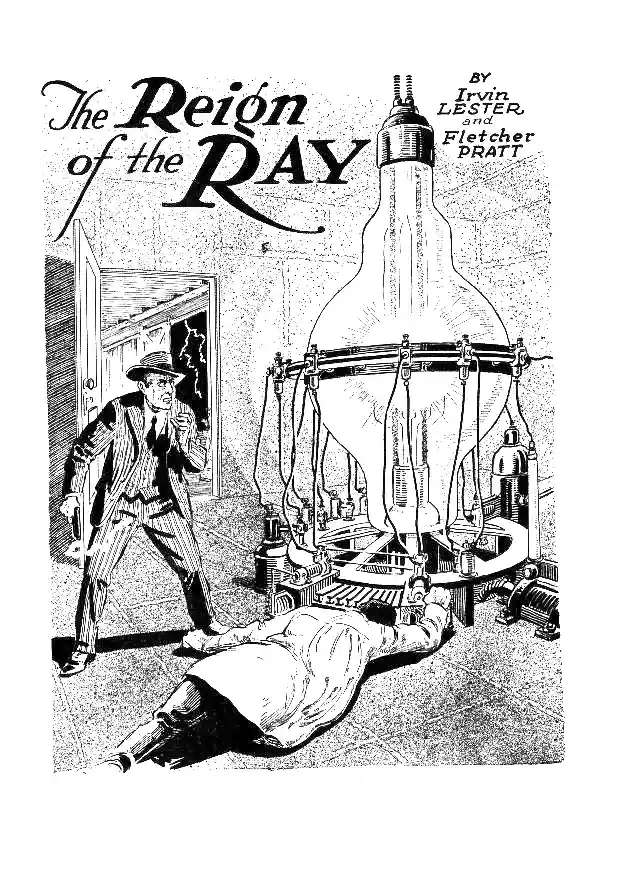
The Reign of the Ray (1929) – Irvin Lester and Fletcher Pratt | Science Wonder Stories
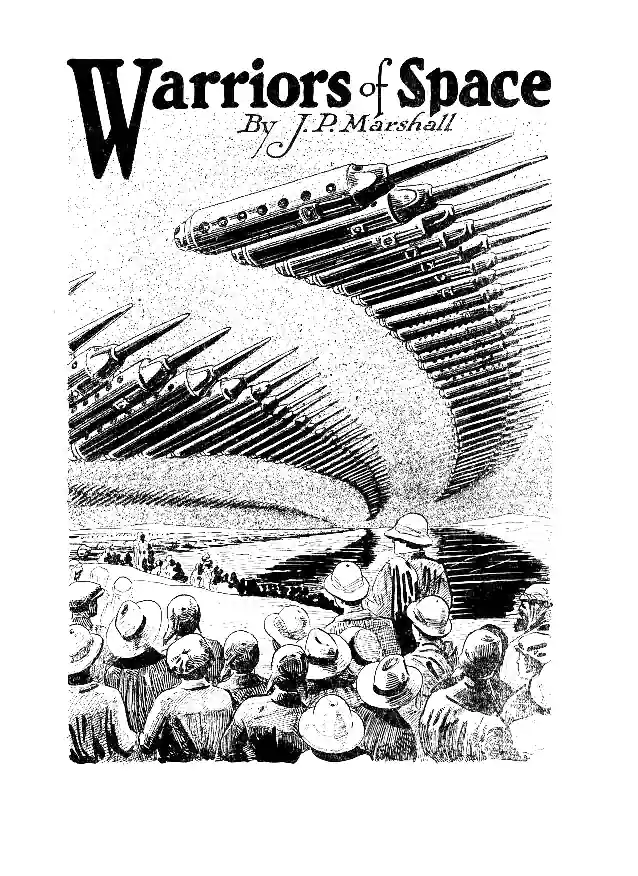
Warriors of Space – James P. Marshall (Science Wonder Stories, Vol. 01, No. 1, 1929)

The Marble Virgin – Kennie McDowd (Science Wonder Stories, Vol. 01, No. 1, 1929)

The Threat of the Robot – David H. Keller (Science Wonder Stories, Vol. 01, No. 1, 1929)