The Dark Rites of Arkham: Story and Review
Title: The Dark Rites of Arkham
Developer: Postmodern Adventures
Publisher: enComplot
Release Date: February, 2026
Genre: Point-and-click / Mystery / Lovecraftian Horror
Engine: Adventure Game Studio (AGS)
Platforms: Windows
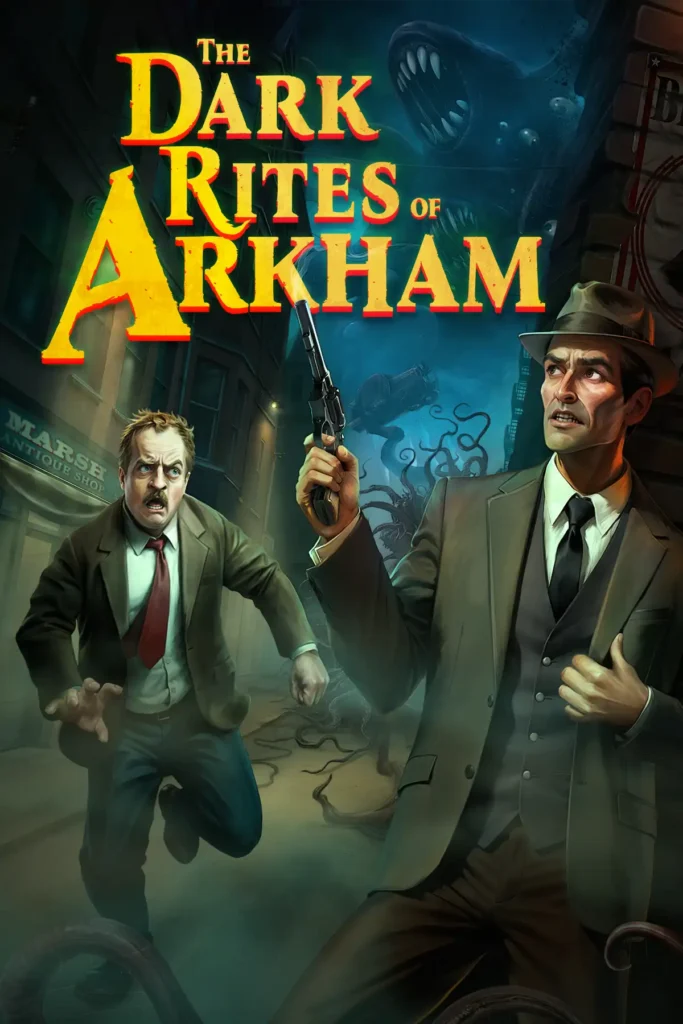
“The Dark Rites of Arkham”, developed by the solo studio Postmodern Adventures and released in February 2026, is a point-and-click horror adventure that captures the pulp spirit of H.P. Lovecraft’s stories in a very faithful way. Set in a noir Arkham of the 1930s, the game mixes police investigation with cosmic horror. It adapts and brings together several of the author’s tales to create its own story, one that is at times delirious and at others really fun.
What starts as a seemingly simple case of political blackmail soon turns into a macabre ritual of locked-room murder. You control the detectives Jack Foster and Harvey Whitman, a charismatic duo who carry the plot with sharp dialogue and plenty of personality.
The Story of "The Dark Rites of Arkham"
Arkham, 1933
Set in the 1930s in the shadowy city of Arkham, Detective Jack Foster arrives at a run-down block of flats to investigate room number 13. He had been suspended from the police force for a while after a traumatic incident, but now he is back on the job. Inside, Foster finds a man named Júlio slumped on the floor, blind drunk. After a quick search, he discovers the item he came for: a photograph of the respected Bradley with a woman who appears to be his mistress.
As Foster leaves the flat, a strange smell drifts from the neighbouring room. He forces the door open and steps inside. There, he comes across a man lying dead with his head completely torn off. The body rests inside a ritualistic circle and bears an unusual tattoo across the back. Nearby, Foster spots a peculiar stain on the wall and a severed, half-charred hand. Curiously, it seems impossible for anyone to have entered or left through the door.
A New Partner
Back at the station, Foster speaks with the chief of police, who assigns him to the case. The chief mentions the mayor Bradley and the speech he will deliver later that same evening. He also hints that the mayor is suspected of ties to a racist group, and his public words often reveal his prejudiced views. Reluctantly, the chief orders Foster to work alongside a new colleague, Harvey Whitman.
While walking through the corridors, it becomes clear that Foster is not welcome among his fellow officers because of the earlier incident. His old partner, McCarthy, had died during that event, and many still blame Foster for what happened.
Whitman has already started digging into the case. He explains that the strange symbol acts as some form of protection against an unknown force, while the charred hand likely resulted from spontaneous human combustion. To learn more about the symbol, Whitman has been corresponding with a contact through letters. As for the combustion, a specialist named Phillip Moore is giving a lecture in Arkham and could provide vital clues.
The two detectives head to Ishitar’s Gate bookshop, where they manage to meet Phillip Moore. After examining the crime scene photos, Moore realises this is something far more serious. He calls in his assistant, an expert in Arkham’s witchcraft history, who tells them an old tale from the Puritan era. Three witches – Keziah Mason, Mary Warren, and Abigail Revell – simply vanished from their prison cells, leaving only a strange mark behind. According to the expert, the stain on the wall of the flat is a portal created by one of these very witches.
The Innsmouth Connection
Next, the detectives visit Benjamin Marsh, Whitman’s pen-friend and owner of Marsh Antiques. They soon learn that Marsh comes from Innsmouth, home to the infamous fish-like people. At first, Marsh refuses to help the police, but he eventually mentions an incident at the Arkham Museum. With few other options, the pair head there to investigate.
At the museum, they discover that Marsh once tried to steal a Cthulhu effigy, which sparked a fight with security. The place itself is a tribute to Lovecraft’s stories, featuring images of Herbert West, Erich Zhann and other well-known characters. The Cthulhu statue had been taken as evidence to the police station, so Foster and Whitman find a way to retrieve it.
As thanks for recovering the Cthulhu statue, Benjamin Marsh shares new information. He reveals that Professor Thackeray has the same tattoo as the one found on the headless body. The symbol belongs to a secretive order, and Thackeray can be found in a restricted library inside the infamous Miskatonic University. Unfortunately, neither the police nor anyone else has permission to enter that library.
Therapy and Trauma
Meanwhile, Foster has been attending mandatory therapy sessions with Dr Steiner. The goal is to uncover exactly what happened during the traumatic event that led to McCarthy’s death. However, Foster’s memories remain hazy and blocked. Dr Steiner suggests hypnosis, but he has resisted so far. In the end, he agrees to the session and finally sees the full truth of that night.
Foster and McCarthy had been staking out the docks of Arkham, watching a ship suspected of smuggling. When the cargo was loaded onto a lorry, the two officers were spotted. A chaotic car chase and shootout followed. They pursued the vehicle to the edge of the city, where the lorry lost control, crashed into the woods, and came to a stop.
While checking the wreckage, McCarthy grew uneasy about the surroundings. He began talking about the insignificance of humanity in the vast universe. Then, in a sudden act of despair, he shot himself in front of Foster. Before Foster could react, a horrifying creature emerged from the lorry’s cargo. The sight was so overwhelming that Foster passed out.
When he came to, he was back in Dr Steiner’s office.
Confronting the First Witch
The investigation now turns towards locating the three mysterious witches. The detectives knock on the door of an old house once owned by Keziah Mason. It now belongs to an elderly woman who rents out the attic to a tenant named Stuart. He claims the house is haunted by a witch who appears in the attic at night.
Foster and Whitman wait in the attic, hoping something will happen. While they wait, Whitman opens up about his wife and his son. His wife, Teresa, had become involved with a strange cult and grew increasingly devoted to it. Eventually, she sacrificed their child in a ritual. Whitman came to Arkham specifically to find her and make her pay for what she did.
Their conversation ends when Keziah steps through a portal into the attic. Caught by surprise, the witch is quickly surrounded by the officers.
The three of them cross through the portal and emerge in a bizarre city filled with strange symbols and alien futuristic technology. Time itself feels distorted in this place. It is inhabited by beings covered in eyes who speak the Mi-Go language, which Whitman learns to understand using a strange device.
Foster and Whitman corner Keziah, but she swears she had nothing to do with the murder. In a moment of tension, Foster shoots her in the head. He and Whitman then escape back through the portal to the real world.
The Second Witch
The next target is Mary Warren. While questioning a street preacher, Whitman recognises the man from a cult he once infiltrated undercover. The preacher explains that he left the group after a powerful woman joined them. The cult is now gathering in the woods, and to reach them the detectives must climb a monolith on the outskirts of Arkham.
After ascending the stone, they are approached by mysterious men in suits and hats. These “observers” warn Foster and Whitman to drop the case before disappearing. Soon afterwards, cult members arrive and take the detectives to their camp. The group appears to be a typical isolated religious sect with strong nature-worship beliefs and hippie-like ideals.
During a meeting where one member is being punished, Foster slips away to search for the witch. Inside a warehouse marked with a strange symbol, he finds a magical stone that reveals Mary Warren hiding behind it. Like Keziah, she claims no connection to their murder case.
Before they can leave, the cult members and their leader surround them and release a “guardian” – a monstrous creature resembling a Shoggoth, possibly the same one that traumatised Foster before. As they flee through the forest, Whitman begins showing the same disturbing symptoms as McCarthy, speaking of the vastness of the universe. He raises his gun to his own head just as they reach a cliff edge with the creature closing in.
At the last moment, Foster grabs Whitman and they both leap into the water below.
The Final Witch
The last witch, Abigail Revell, runs a divination shop in town. Although the place looks empty at first, Foster notices the same pentagram that Mary used. Suddenly, Whitman finds himself in an illusion: he appears much older, living in a typical American neighbourhood, and receives a visit from his grown-up son. Realising it is a trick, he breaks free from the vision.
Foster immediately points his gun at Abigail, who finally agrees to talk. She admits opening the portal inside the murder flat. Two men had come to her; one of them, Wilbur Whateley, lost his hand during the crossing. Abigail also cursed one of them so that he would bleed whenever he tried to speak. In exchange for her life, she opens a portal for the detectives straight into the restricted library at Miskatonic University.
Secrets of the Forbidden Library
Inside the library, the detectives meet Professor Armitage, Thackeray, and Francis Morgan. They reveal that the headless victim was Warren Rice, a fellow member of their group dedicated to protecting humanity from dark forces. Since only they knew Rice’s location, one of them must be the killer. Thanks to Abigail’s curse, Francis Morgan is unable to speak, exposing his guilt.
Using a spell, Morgan tricks the others, uses Rice’s head to bypass the security system, and escapes with the Necronomicon. The professors then show a holographic message from a being from another planet called Ayeb. He explains that his own world was destroyed when cultists summoned Yog-Sothoth. Now, a similar ritual is planned on Earth during tonight’s planetary alignment. This cult is led by Mayor Bradley and his family.
Hebert West’s Serum
Foster and Whitman head to the theatre where Bradley is giving his speech. They split up, with Whitman going after his ex-wife Teresa. Foster tries to convince the chief of police of the danger, but the chief dismisses it as complete nonsense.
During the speech, Bradley suddenly becomes possessed by the Supreme Witch. In a bloody moment, he blows his own brains out. With Bradley dead and no clear answers, the detectives go to Arkham Prison to speak with Herbert West.
West reveals a secret laboratory in the prison basement where Dr Moreland has been creating zombies from the inmates’ corpses. Foster decapitates the immortal Moreland and takes West’s serum. They use it to revive Mayor Bradley, who confesses that he never wanted to summon Yog-Sothoth – he only wanted to remain in power. The true mastermind is Teresa, the Supreme Witch, who is performing the ritual on the roof of the town hall. The photo of Mayor Bradley with the woman makes sense now: It was Teresa.
A Well-Earned Drink
Foster and Whitman rush to the roof, eliminating both Francis and Wilbur. Only Teresa remains. The city is already descending into chaos as Yog-Sothoth’s presence grows stronger. While Teresa recites passages from the Necronomicon, Foster tries to stop her, but she overpowers him with dark magic.
With no other choice, Whitman shoots Teresa, ending her life. Using his knowledge of the Mi-Go language, he then recites the counter-spell and sends Yog-Sothoth back to where it came from.
Exhausted, Foster and Whitman realise it is already past midnight. With Dry Law Prohibition finally over, they decide to celebrate the end of the nightmare with a well-deserved drink.
Mythos
One of the main features of the game is the city of Arkham itself–alive and fully explorable. In the stories, Arkham is located in Essex County, Massachusetts, and it was first mentioned in “The Picture in the House”. Without doubt, it is the setting that appears most often throughout Lovecraft’s tales. Even though it shows up so frequently, the author never explores the town in great detail, usually just mentioning it as a quick reference. Still, over time Arkham has gained a rich visual identity among fans of this cosmic mythology. The most important landmark in Arkham is Miskatonic University, home to the infamous Necronomicon.
Armitage, Warren Rice and Francis Morgan all have access to the book in the university library. Both they and Wilbur Whateley are characters from “The Dunwich Horror”. In the story itself, Wilbur dies while trying to steal the Necronomicon from the university. He and his family were carrying out a plan to summon Yog-Sothoth, Wilbur’s father—a ritual that was stopped by Armitage and the others.
As for the Mi-Go, they are a race that lives on the planet Yuggoth. They are described as technologically highly advanced, which explains the futuristic city you see. Since the city shows bodies being studied and brains being used for certain purposes, it does look like a clear case of Mi-Go activity.
Another relevant part involves the witches. Keziah Mason, also known as Nahab, appears in the story “The Dreams in the Witch House”. She possesses powers that allow her to travel between dimensions and haunt Gilman’s dreams in the attic of a haunted house in Arkham.
Innsmouth also gets its moment in the game, where Benjamin Marsh belongs to the Marsh family that cursed the town. We even see the participation of Herbert West himself, who created a serum capable of bringing the dead back to life.
On top of all that, throughout the story you spot plenty of other small references to Lovecraft’s works.
Investigating a Pixelated Arkham
The game follows the old-school point-and-click formula to the letter: exploration, long dialogues, item collection and inventory puzzles. The narrative is the driving force of the experience, without any doubt. There is quite a lot of text and conversations, but on the whole they flow well and do not become tiring. One of the highlights is the comic tone that appears in several moments. This pulp humour is very welcome here, especially when the player needs to find ultra-elaborate solutions for simple problems. Mixing dozens of Lovecraft tales into one absurd plot could easily have fallen into ridicule, but here it works as an irreverent homage.
Another point that really shines in “The Dark Rites of Arkham” is the visuals. The pixel art is impeccable, with more than 70 richly detailed background screens (I’m not sure of the exact number). At last you get the chance to walk through the streets of Arkham and truly feel the mysterious atmosphere that Lovecraft described. Every location, whether the police station, an antique shop or the corridors of Miskatonic University, feels alive and believable. The scenes are full of interactive elements that reinforce the immersion: posters on the walls, objects on the shelves, NPCs with dialogues and small details that give personality to the world. You really feel like you are walking the streets of Arkham, absorbing the mystery and decay that define the city.
Narrative Approach
One of the best narrative decisions here is not overloading the player with excessive explanations about the lore. The more familiar you are with Lovecraft’s works, the more references you will catch. But none of that is required. The narrative stands on its own and anyone can follow along and enjoy it simply by paying attention to the information presented in the game. This makes “The Dark Rites of Arkham” accessible both to veterans of the Cthulhu Mythos and to those who have no interest in it at all.
In terms of duration, the game is relatively generous for the genre. Most players take between 5 and 7 hours to complete the main story (with an average around 6 hours), which puts it in the ideal range: long enough to feel worth the investment, but without stretching out unnecessarily.
The progression follows the classic adventure game loop: interacting with characters, solving puzzles, collecting clues and unlocking new destinations on the city map. Each new piece of information opens doors (literally), expanding the possibilities for exploration and creating a natural sense of progress. The game flows well most of the time and avoids critical roadblocks, although some puzzles have more obscure or “creative” solutions.
As with almost every detailed pixel-art point-and-click game, there is the classic problem of hotspots that are difficult to see at first glance. However, the game solves this in a simple way: when you move the cursor over important elements, a text appears, making it clear what can be examined or used. This makes the experience much smoother.
“The Dark Rites of Arkham” is yet more proof that Postmodern Adventures (responsible for titles such as Nightmare Frames and An English Haunting) has established itself as one of the modern references in horror adventures. It’s an experience that intelligently balances cosmic terror, pulp humour and pixel art that borders on perfection.