
Atomic New Age

Introduction

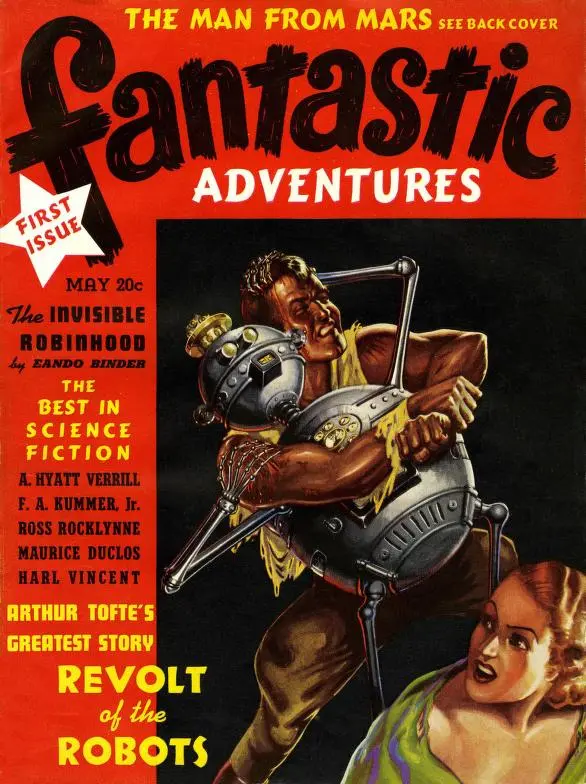
“Adventure in Lemuria” is a short story written by Frederick Arnold Kummer Jr. and published in the pulp Fantastic Adventures. It’s a proper old-school sword-and-sorcery tale that throws a wandering bronze-age warrior into the lost continent of Mu, or Lemuria. And, well, Expect fast-paced action, no-complex political intrigue, native rituals, and a classic pulp hero who solves most problems with a sharp sword and a lot of luck.

Plot Summary of "Adventure in Lemuria"

Khor the Wanderer, a bronze-age warrior from Crete, arrives in the mysterious land of Mu (Lemuria) after more than a hundred moons of eastward travel. Shortly after entering a peaceful grove near the city of Zac, he stumbles upon a desperate battle where a young man in a blue mantle fights against overwhelming odds. Khor’s intervention saves the stranger’s life and draws him into a deadly political conspiracy involving a usurped throne and dark religious rituals.

A Competent Adventure Author

Kummer’s story is a classic sword-and-sorcery adventure, with a touch of historical pseudorealism mixed with mythology and fantasy. Lemuria is a made-up lost continent, supposedly somewhere in the Indian or Pacific Ocean, and it doesn’t need too much accuracy beyond being an exotic setting. The pacing of the narrative is, as you already know, fast and packed with action. But the fight scenes are really well choreographed, I have to say. Apparently Kummer did some proper research into actual Minoan culture to write the bull-leaping sequence, where such athletic displays were recorded in real life.

Khor himself is the archetypal hero straight out of the Conan mould: physically powerful, extremely capable, with simple tastes and a rough sense of honour. But sadly, there’s not much more to him than a pair of blue eyes and external dangers to deal with. He acts because heroes act, and that’s enough.

As for Lalath, her character shows us a bit of the standard archetype for powerful female figures back then – portrayed as demonic and highly sexualised, the classic “Witch-Queen” type.

Kummer’s prose aims for something a bit archaic, although there are certain phrases that break the illusion. His formal diction creates some distance from modern speech, but without fully committing to authentic language from that period. His descriptions, as you’d expect, are full of adjectives and movement that heighten the reader’s sensations, with emotions being named rather than shown.

Lost Civilization Culture

Lemuria is yet another example of the Western obsession with lost continents and hidden or extinct civilisations. We see this kind of story all over the place in Jules Verne’s tales and adventure fiction in general. Most of these stories involve finding clues to a lost world that’s still very much alive – and curiously, everyone seems to speak English. The idea of Lemuria originally came from 19th-century geological theories trying to explain how species spread across the world through land bridges. These ideas were later picked up by Theosophists like Helena Blavatsky and other occultists. According to them, there were ancient, super-advanced civilisations holding mystical knowledge that shaped the modern world. Their remnants, however, were wiped out or hidden because they could change everything we think we know. Atlantis is probably the most famous example of this whole thing.

By around 1939, Lemuria lived mostly in popular fiction and fringe speculation, and of course had been long abandoned by proper science. It’s very similar to the hollow earth theory we talked about in another story.

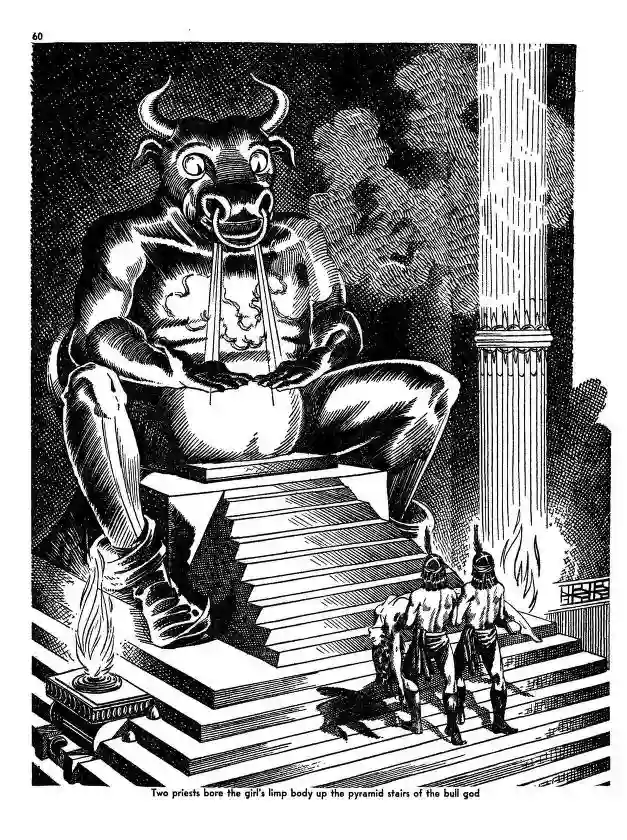
Another thing these stories love is showing “native” religions and rituals as strange and exotic. In this case, the bull sacrifice draws from real practices in the ancient Near East and Aegean region, which archaeology had uncovered at the start of the 20th century. The Minoan bull-leaping is shown in the frescoes at Knossos, we have the biblical references to sacrificing to Moloch, and the Oracle at Delphi – all these historical bits condensed into Lemuria. It gives this type of fiction a bit of authenticity. Basing stories on real antiquity was that common at the time, and you could find it even in horror tradition.

Author: Frederick Arnold Kummer Jr.

Frederick Arnold Kummer Jr. is a somewhat obscure author, even though he wrote a large number of short stories during his career. If you search for him, you’ll almost certainly come across Frederick Arnold Kummer Sr., who is a different person, and there’s no clear evidence they were related – at least from what I could find. Sites like Wikipedia make a really poor job of linking the two names and their works. The SF-Encyclopedia, on the other hand, seems to treat them as the same person, or at least father and son. So I’ll leave that question open for you lot.

The ISFDB is more straightforward about them being father and son, clearly separating the works of Kummer Sr. and Kummer Jr. I have to admit I’m not entirely sure about all of this. But speaking of Kummer himself – the Jr., not the Sr. – his stories have that adventurous spirit with lost civilisations and space adventures. Lemuria returns in “Intrigue in Lemuria”, and there’s also the short story “Volcano Slaves of Mu”. Kummer knows how to work well within the genre and does everything competently here, but there doesn’t seem to be any particular ambition beyond delivering a solid adventure, which is fair enough.

My Thoughts

To be honest, “Adventure in Lemuria” feels a bit empty despite the competent execution. It’s a story without many surprises and seems to have been written exactly to fit the guidelines of a pulp adventure like most others – you just change the protagonist’s name and the setting. Even the evil queen doesn’t have much to say. Nothing particularly memorable, despite the professional finish.

Perhaps the issue is the voice. Stories like Conan and John Carter of Mars had already given readers something extra: not just future tropes, but a distinctive authorial voice and personality. Here you don’t really find anything unique, which makes the story feel less alive, especially when it’s mostly a string of familiar tropes. Khor is a generic Conan, he never thinks anything surprising, never reacts in a curious or unexpected way, and never gets into a situation that raises any real questions. John Carter is a fish out of water in an unknown world, and Conan is a barbarian who makes us rethink what “civilised” even means. In other words, there’s something meaningful in how the character relates to his world, and therefore to us readers. You won’t find it here.

Wrapping Up

“Adventure in Lemuria” might have been fun at some point in the past, but not as much as other works in the same niche that came before it. It’s a competent sword-and-sorcery tale with dangers and a triumphant hero that probably entertained its contemporaries for a moment before fading away. That’s just how it goes, especially with the massive production of stories needed to fill the monthly issues of dozens of pulp magazines. This one is pretty generic and doesn’t have much to say – even the voice and execution don’t set it apart from the better examples already out there at the time.

In the end, it turns Adventure in Lemuria into something of a historical artefact of literature: a basic example of competence in the genre and the standard output that didn’t achieve any lasting distinction. A straightforward adventure, nothing more and nothing less. That’s what it offers, and like its wandering hero Khor, it disappears over the horizon into obscurity.

Disclaimer: The story featured on this page is in the public domain. However, the original authorship, magazine credits, and any associated illustrations remain the property of their respective creators, illustrators and publishers. This material is provided for informational and educational purposes only and may not be used for commercial sale.

Scroll to Top