

Atomic New Age

Introduction

“The Sleeping Goddess”, written by Maurice Duclos, is one more fast-pacing adventure we are all used to around here. But, I believe there’re a surprise or two that help the story overcome the barrier of being completely forgettable. Written efficiently, as expected, Maurice Duclos, adds some elements that propel the narrative beyond mere enthusiasm, with a villain that has more substance and a scientific philosophical ambition. Is that enough? Let’ see it.  

Plot Summary of "The Sleeping Goddess"

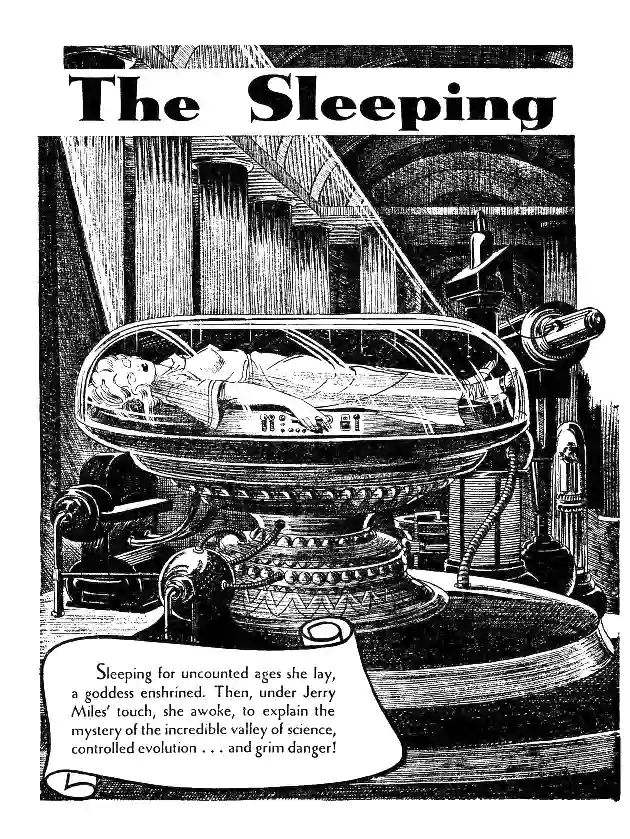
A brash American adventurer named Jerry Miles stumbles upon a strange structure in the deserts of northern Afghanistan: a towering wall of transparent glass enclosing an entire valley ecosystem. Driven by curiosity, he scales the barrier and descends into a world sealed from the outside — a dense jungle bathed in blue-green gas, populated by a primitive people ruled by the seductive High Priestess Neena and her obedient mechanical servants

The Adventure Setup

“The Sleeping Goddess” is one of those classic pulp adventures where the hero gets dropped into a weird and curious world and has to face one challenge after another without a moment to catch his breath. This time we’re in… Afghanistan… to uncover a secret ancient civilisation that actually turns out to be pretty interesting. The story opens with that lovely sense of wonder as you discover the mysterious setting: a massive glass wall rising out of the Afghan desert, something almost alien and really dazzling. Then it quickly shifts into a chase narrative, leaving behind the heavier ideas from the start.

“The Sleeping Goddess” doesn’t stray far from what you’d expect from this sort of adventure. It follows the usual pattern: discovery, immersion in the strange world, fights, a bit of revelation, and then escape. The tale does throw in a love triangle, for better or worse. On one side you’ve got Neena, the dark, powerful and sensual woman, and on the other Orleen, the wise and calm one. Of course the story resolves in favour of Orleen, in line with the moral conventions of the time. Neena’s “perilous beauty” is treated as a clear warning. You can probably guess the characters don’t offer many surprises, and they really don’t. Neena is the best thing in it — wrapped in clichés, but with a more ambiguous and consistent villainy.

The story plays with a tension between knowledge and life, order and chaos, or something along those lines. But, it has more interesting symbolism than it first appears. The folkloric figure of the sleeping beauty waiting to be awakened, the image of a goddess worshipped by a whole civilisation, even the voluntary and carefully planned hibernation as an ambitious scientific project. Jerry accidentally waking the goddess shows how this carefully maintained order usually gets overturned by human curiosity — and even more by events you just can’t control. It’s a jab at the idea of trying to impose total order on a world full of surprises, basically.

The glass itself becomes a boundary between order and the chaotic world outside, which we know better as reality. You have to cross that barrier, where on one side evolution is treated like a controlled experiment and on the other it’s just… real life.

Why Afghanistan?

Thinking about Afghanistan as the setting for this tale tells us more than it first seems. Honestly, Afghanistan doesn’t really mean anything specific here. There’s no real Afghan culture or anything that justifies the choice of location. It’s simply used as a remote and exotic place that holds a peculiar spot in the Western imagination. The thinking seems to be: I need a foreign location that’s different from the usual ones — so, the Afghan desert. It’s far enough away that the author doesn’t need to worry about too many accurate details. It’s basically a blank canvas for the writer to fill in. And, as always, the Americans are there having their adventures and exploring the place like proper trailblazers.

Author: Maurice Duclos

Maurice Duclos wasn’t a particularly famous writer, and he suffered from one of those common and unfortunate problems in the business: sharing a name with someone more well-known. It’s quite possible Maurice Duclos is a pseudonym, a very common practice in pulp magazines. Prolific writers used them to avoid flooding the market with their own name. It let them publish loads of stories without the magazine looking like it only used the same person over and over. From the style of the writing, this is clearly someone comfortable with the type of story and audience he’s working for. He keeps it interesting enough to hold the reader’s attention while adding a nice bit of cynicism towards the genre.

My Thoughts

A few things help “The Sleeping Goddess” stand out a little from the sea of pulp adventures, mainly the more intellectual ambition behind the tale. Like it or not, a cool central concept is often what carries a science fiction story, and that’s where I’d put this one. The idea of an evolutionary terrarium sounds brilliant and full of possibilities. Watching life in a glass box where nothing ages “naturally” is properly mad. The implications of that for the characters, barely explored through Orleen, show centuries of loneliness. To the folks themselves, primitivism and superstition. 

Neena, even though she’s a bit clichéd, is still an interesting figure because of her position. She understands everything about that world, knows the robots are just technology, knows the prophecy is a cultural invention, and yet she still has to keep the whole social order running. The weight of knowing the truth but not being able to share it with anyone else… she’d definitely make a better protagonist. Here, she’s reduced to a simple obstacle, which feels like a waste.

The ending doesn’t quite match the story that came before it. It’s not terrible on its own, but all that careful observation and setup leads to nothing, and everything stays primitive. Then it’s all thrown away when even Orleen gives up on it. It feels a bit too pessimistic for what is supposed to be a triumphant adventure.

Apart from that, there’s not much more to say. It’s a collection of tropes you’ve seen loads of times in different places: the square-jawed adventurer, the impulsive and sensual empress, the unusual setting with advanced science (especially robotics), and the weird and usually dodgy social hierarchy.

Wrapping Up

“The Sleeping Goddess” is well made, well written and well thought out as a pulp adventure, but there’s not a huge amount to discuss afterwards. Suspended animation is the big selling point, especially as it wasn’t that common at the time. However, as usual, character development gets pushed aside to make room for action, and that rarely ages well. The characters mainly exist to discover the world, get in the way, and explain the world.

The central image is excellent and vivid, and the scientific premise is interesting too. All of it delivers that sense of wonder this type of story aims for and offers some nice subtext beneath the surface. It could definitely have spent a bit more time showing why you shouldn’t spend years of your life just observing the world — and should get out there and live it instead.

Disclaimer: The story featured on this page is in the public domain. However, the original authorship, magazine credits, and any associated illustrations remain the property of their respective creators, illustrators and publishers. This material is provided for informational and educational purposes only and may not be used for commercial sale.

Scroll to Top