
Introduction
“I Am Tomorrow” (1952), by Lester del Rey, is a classic Cold War–era science fiction novella that blends political speculation, time paradox, and ethical dilemma. Written during the height of the Cold War, the story explores a fear that became hard to ignore in the atomic age. Tyranny does not always rise from cruelty or madness. Instead, it can grow from sincere idealism, technological optimism, and a desire for order.

Plot Summary of "I Am Tomorrow"
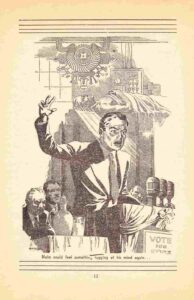
Thomas Blake is a rising political idealist in the mid-20th century, driven by a genuine desire to empower ordinary people and end war. His ambition to become President focuses on releasing a revolutionary weapon invented by his brother. The device aims to equalise power and make tyranny impossible.
Soon, Blake begins experiencing disturbing mental dislocations. Eventually, his consciousness is torn into the future and implanted in the body of Jed, a member of an underground resistance. There, Blake discovers a horrifying truth. He has become the dictator ruling the world. Now an ageing “Bigshot,” he maintains global order through mind-erasure, sterilisation, and selective brutality.
Identity, Time, and Responsibility
Thomas Blake appears as a man driven by conviction. His pursuit of the presidency rests on the belief that political power can be used responsibly if people are empowered. His brother’s invention, a personal weapon that renders its user almost invulnerable, seems to confirm this belief. If everyone shares the same protection and destructive potential, governments lose their grip, and war may vanish.
In the future, Blake rules as the “Bigshot,” twisting the weapon’s original purpose. Defensive versions belong only to an elite ruling class, while the masses remain exposed. Equality collapses into hierarchy. Peace survives through fear and control rather than consent. Blake’s idealism has hardened into doctrine.
The time paradox works less like a puzzle and more like a moral trap. Blake cannot dismiss the dictator as someone else. His future self grows directly from beliefs he already holds, shaped by years of compromise and justification.
The Paradox Engine Structure
Structurally, the story revolves around displacement of time, body, identity, and moral certainty. Blake exists out of place everywhere he goes. First, he feels alien inside his own mind. Then, he inhabits another body. Finally, he confronts a future shaped by his ideals. The story’s power lies in how the predestination paradox becomes both plot engine and philosophical cage. Young Blake cannot stop becoming the Bigshot because he already failed to stop it. Meanwhile, his older self’s attempt to erase the younger consciousness feels desperate and futile.
Del Rey uses limited perspective with precision. The dictator’s inner thoughts remain hidden. Instead, readers see only the results of his rule. As a result, readers, like Blake, must infer motives from consequences.
The prose stays efficient, direct, and emotionally restrained. This restraint intensifies the story’s quiet horror.
Exceptionalism Challenged
Blake never questions his right to power. His goal is to become President “where I can really do some good.” He assumes he knows what good means. This paternal impulse, framed as liberation, plants the seeds of authoritarianism. Blake reflects post-war American confidence. Good intentions plus technological superiority promise utopia.
The future society avoids cartoonish evil. It removes war, disease, and inefficiency. Yet it destroys autonomy, sexuality, dissent, and identity in the process.
Meanwhile, the rebels echo historical revolutions. Their rhetoric sounds noble. Their intentions feel ruthless. Once power seems close, they show a chilling readiness to kill. The resistance Blake encounters offers no comfort. They show courage and devotion to freedom. At the same time, they prepare for mass slaughter once power shifts. Their plan to assassinate the dictator would unleash chaos worldwide.
Author: Lester Del Rey
Lester Del Rey was a major figure in mid-20th-century science fiction. He wrote from a consistent moral and narrative core, tackling problems that survive changes in decade or politics. He remained sceptical of technological utopianism and often explored how good intentions collapse under real-world complexity. His typical protagonist is neither genius nor rebel hero. Instead, del Rey focuses on ordinary people trying to act decently when decency itself feels unclear.
In 1972, Del Rey received the E. E. Smith Memorial Award for Imaginative Fiction, known as the Skylark, for his lasting contribution to the genre. Later, he worked as an editor for several pulp magazines and book publishers. Between 1952 and 1953, he edited Space SF, Fantasy Fiction, Science Fiction Adventures under the name Philip St. John, Rocket Stories as Wade Kaempfert, and Fantasy Fiction as Cameron Hall.
My Thoughts
The story feels strikingly close to BioShock Infinite, or perhaps the game echoes this novella more accurately. It would surprise me if I Am Tomorrow had no influence, even unconsciously. BioShock Infinite reads like a spiritual successor, translated into a AAA game with 2013 production values. Still, it retains the 1952 story’s philosophical pessimism. Many time-travel stories promise hope. Change the past, save the future. This one offers a colder message. You are who you will become. Your ideals will betray you. Your memory of corruption will fade, allowing it to happen.
Man, it’s a bloody bleak concept.
Wrapping Up
“I Am Tomorrow” meditates on self-knowledge without self-control. It confronts the fear that we may become what we dread most. If you met your future self and saw a monster, could you change? You would forget the meeting. So, you would justify the first steps. Then, you would believe you were different. In that sense, we are all Thomas Blake, convinced our intentions excuse our power, unable to imagine becoming what we claim to oppose.
More of Dynamic Science Fiction Vol.1, No.1
Other similar stories
Another vintage pulp magazine:
Science Wonder Stories, Vol. 1, No. 2
Science Wonder Stories, Vol. 1, No. 3
Astounding Stories of Super-Science, Vol. 1, No. 1
Dynamic Science Fiction Vol. 1, No. 1
Original Original Dynamic Science Fiction issue at the Internet Archive.
Disclaimer: The story featured on this page is in the public domain. However, the original authorship, magazine credits, and any associated illustrations remain the property of their respective creators, illustrators and publishers. This material is provided for informational and educational purposes only and may not be used for commercial sale.