
Introduction: The Alien Intelligence Part II
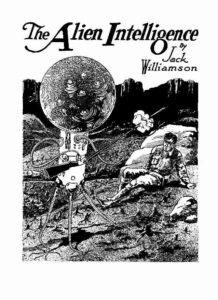
Published in 1929 during the formative years of pulp science fiction, The Alien Intelligence by Jack Williamson stands at the crossroads between scientific romance and modern speculative fiction. At first glance, it appears to be a classic lost-world adventure set in the remote Australian bush. Yet beneath the surface, the plot offers a far more ambitious exploration of evolution, intelligence, and moral responsibility.

Plot Summary of "The Radium Pool"
The narrative follows Winfield Fowler, a young man who journeys into the Australian desert after receiving urgent radio messages from his mentor, Dr Horace Austen. What begins as a rescue mission becomes an exploration of a hidden world inside a vast crater. In this place, a lost civilisation, strange flying craft, and a mysterious silver substance hint at a power far beyond human understanding.
Another Sci-Fi Adventure
The story balances pulp adventure with philosophical speculation. What initially resembles a lost-world romance evolves into something darker and more intellectually ambitious. To achieve this, Williamson blends action sequences—battles, jungle fires, and duels with mechanical beings—with scientific exposition. Narrated in the first person, the tale filters cosmic horror and wonder through the emotional perspective of the protagonist.
Beyond the action, Williamson combines adventure with early hard science fiction. The crater functions as a microcosm or a sealed evolutionary experiment. Red jungles suggest primal life, while the silver lake represents distilled, weaponised energy. On top of that, the prose emphasises atmosphere through repeated visual motifs, such as crimson forests and purple mist. These elements create a surreal, almost expressionistic landscape that reinforces the sense of an unnatural world.
First appearing in Science Wonder Stories, the narrative emerged during the golden age of pulp. Editors such as Hugo Gernsback encouraged tales that combined excitement with scientific speculation. At that time, the public felt a deep fascination with radio, electricity, and atomic theory. The interwar period also shaped the tone, as faith in progress mingled with a fear of its misuse. In short, the crater becomes a metaphor for industrial destruction—an isolated experiment whose consequences threaten the wider world.
Author: Jack Williamson
Jack Williamson was one of the foundational figures of American science fiction, with a career spanning many decades. Even in this early work, he demonstrates interests that would define his later writing: evolutionary speculation and machine intelligence. Furthermore, he focuses on the ethical burdens of scientific progress.
My Thoughts
What stands out most is how forward-looking the story feels. The evolutionary speculation recalls The Time Machine by H. G. Wells, particularly the vision of divergent species shaped by their environment. In addition, the presence of a hidden intelligence manipulating humanity from the shadows remains a compelling trope.
Wrapping Up
The Alien Intelligence begins with adventure but culminates in a philosophical confrontation. By situating an advanced civilisation within Earth’s own geography, Williamson collapses the distance between the familiar and the incomprehensible. To conclude, the book serves as an early exploration of dilemmas that still shape the genre today.
Other stories from Science Wonder Stories
Another vintage pulp magazine:
Science Wonder Stories, Vol. 1, No. 2
Astounding Stories of Super-Science, Vol. 1, No. 1
Original Science Wonder Stories issue at the Internet Archive.
Disclaimer: The story featured on this page is in the public domain. However, the original authorship, magazine credits, and any associated illustrations remain the property of their respective creators, illustrators and publishers. This material is provided for informational and educational purposes only and may not be used for commercial sale.