
Introduction
“The Boneless Horror”, written by David H. Keller and published in Science Wonder Stories Vol.1, No.2 is one of the most chilling tales from the early days of pulp. Keller drew upon his medical knowledge to craft a story that blends alternate history with gore horror. Moreover, the narrative explores themes of revenge, hubris, and the catastrophic consequences of power.
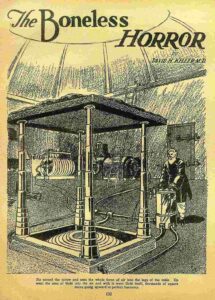

Plot Summary of "The Boneless Horror"
“The Boneless Horror” presents an alternate history of Earth where three great empires—Gobi (Asia), Mo (Pacific), and Atlantis (Atlantic)—existed 14,000 years ago. When the Emperor of Gobi demands immortality, a captured physician from Mo named Heracles provides a life-extending food while secretly plotting revenge. Furthermore, as Gobi plans to destroy Mo through underground explosives, Mo prepares to lift Gobi into the freezing sky.
Three Reigns In Conflict
“The Boneless Horror” operates as a grand tragedy disguised as pulp adventure, delivering one of early science fiction’s most nihilistic visions. It belongs to the lost civilisation subgenre of science fiction. Keller constructs an elaborate alternate history where mutual hatred between great civilisations leads to their simultaneous destruction, reshaping Earth’s entire geography and erasing all human cultural achievement.
The three empires represent different aspects of civilisation, yet all prove equally vulnerable. Military might (Gobi), scientific advancement (Mo), and cultural sophistication (Atlantis) all perish. No attribute protects against annihilation when hatred and violence dominate.
Moreover, both Gobi and Mo succeed in destroying each other, and their very success destroys them both. Neither empire wins. As a result, there are no survivors to celebrate victory, and no culture remains to remember any triumph. The mutual annihilation proves so complete that 14,000 years later, only geological features survive as evidence these civilisations existed.
Keller’s medical background infuses the story with clinical detail that heightens the horror. Osteomalacia is a real disease causing bone softening, which makes Heracles’ weaponisation of it feel plausible despite the fantastical longevity element.
Pulp Tragedy
Keller employs third-person omniscient narration that shifts freely across vast space and time. Readers visit the Emperor’s throne room, Heracles’ laboratory, the Emperor of Mo’s banquet, and even jump forward 14,000 years to Arizona prospectors. The prose style remains straightforward pulp efficiency with occasional poetic flourishes. Phrases like “worm food and dust in their golden coffins” or “fateful handwriting of Time the Conqueror” therefore elevate the writing.
Heracles functions as the story’s true protagonist despite his villainy. He infiltrates enemy territory, gains complete trust, provides a valuable service (genuine life extension), and simultaneously prepares their doom. His specific revenge—condemning them to eternal life as boneless horrors—shows he wants them to suffer forever. Consequently, the structure follows classical tragedy: hubris (empires seeking to destroy each other), nemesis (both plots succeeding), catastrophe (mutual destruction), and catharsis (frozen horrors and geological transformation).
However, the story’s flaws are apparent. The prose sometimes slips into purple melodrama. In addition, the casual racism and sexism reflect unfortunate period attitudes, while some plot mechanics rely on convenient coincidences.
Author: David H. keller
David Henry Keller (1880–1966) was an American psychiatrist who served as a military psychiatrist in the First World War, treating shell shock and trauma cases. His work stood out for emphasising a humanistic and sociological approach to science fiction, together with deep scepticism about relinquishing all control to new technologies. On the other hand, critics noted his corrosive attitude toward both science and civilisation, along with anti-feminist and racist tendencies, and occasional sexual sadism.
His stories were once regarded as controversial for their theological speculations and harsh depiction of the battle of the sexes. Over time, however, they became outdated for most science-fiction readers.
My Thoughts
The mutual assured destruction theme feels prophetic of the Cold War nuclear standoff that would not emerge for decades. Two superpowers, each capable of destroying the other, both so committed to their enemy’s annihilation that they trigger catastrophe—this could describe 1960s nuclear brinkmanship as easily as Keller’s fictional empires.
For instance, the story’s casual cruelty—the Emperor killing seven slaves in seven ways just to demonstrate his power, or the month of entertainment involving elaborate executions—establishes a world where life is cheap and power corrupts absolutely. Heracles presents himself as simultaneously victim (enslaved as a child, forced to serve Mo after his family was killed), genius (masters medicine, creates genuine immortality), and monster (condemns men to eternal torture). Readers might therefore struggle with whether to view him as justified in his revenge. Keller does not help—the narrative presents him as clever and determined but does not explicitly condemn or endorse his actions.
Wrapping Up
David H. Keller crafted a story that operates simultaneously as alternate history, revenge tragedy, cautionary tale, and cosmic horror. The story’s greatest achievement lies in making catastrophic success feel inevitable. Both Gobi and Mo pursue victory with complete commitment and scientific ingenuity. Both succeed perfectly in destroying their enemy. And both perish from that very success.
There’s no last-minute salvation, and no heroes prevent disaster. The catastrophe unfolds exactly as planned by everyone involved, which is why it becomes catastrophe.
The world we inhabit—its mountains, oceans, continents—might bear witness to tragedies so ancient and complete that we mistake their monuments for natural features. Meanwhile, somewhere in those mountains might lie horrors that cannot die, frozen but not dead, waiting.
Other stories from Science Wonder Stories, Vol 1, N° 2
Another vintage pulp magazine:
Science Wonder Stories, Vol. 1, No. 2
Science Wonder Stories, Vol. 1, No. 3
Astounding Stories of Super-Science, Vol. 1, No. 1
Dynamic Science Fiction Vol. 1, No. 1
Original Science Wonder Stories issues at the Internet Archive.
Disclaimer: The story featured on this page is in the public domain. However, the original authorship, magazine credits, and any associated illustrations remain the property of their respective creators, illustrators and publishers. This material is provided for informational and educational purposes only and may not be used for commercial sale.