
Introduction
“The Empress of Mars,” written by Ross Rocklynne and published in the 1939 issue of Fantastic Adventures follows Darak of Werg, a warrior on an urgent mission to the hostile Martian empire of Crill. With its fast-paced action, dashing energy, and classic pulp flavour, the tale brings the spirit of planetary adventure fiction.
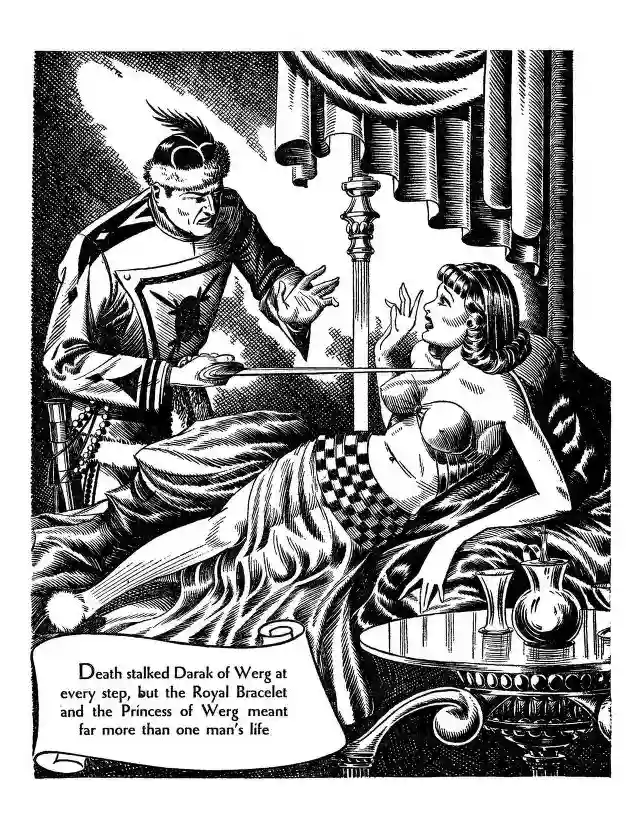

Plot Summary of "The Empress of Mars"
Darak of Werg, a warrior from a small but technologically advanced nation, sets out on a desperate mission to the hostile empire of Crill. His princess has been abducted together with the Royal Hinusian Bracelet, a mystical artefact that grants immortality to the people of Werg. Hunted through the dangerous city of Jador, he must navigate a world of canal pirates, palace intrigue, and watchful guards while following a compass that points toward the stolen bracelet. Along the way, he meets Thilna, a mysterious woman who claims to be a slave, and Paran Leeah, the reluctant Prince Consort to the tyrannical Empress Flavia.
Adventure in Mars
“The Empress of Mars” belongs to the planetary romance subgenre of science fiction. In this type of tale, otherworldly settings mainly provide an exotic background for adventure and romance. The genre grew out of earthly adventure stories, taking the patterns of lost world narratives and swashbuckling historical romances and moving them to alien planets.
The narrative keeps up a constant pace and never pauses for breath. It moves quickly from one perilous situation to the next, which suits the story well and stops readers from noticing any implausibilities. Instead, the focus stays on excitement through a series of well-planned action sequences. The structure follows the classic adventure pattern of steadily growing obstacles. Each chapter brings a new crisis that demands immediate action, such as escaping from guards, infiltrating the palace, stealing the bracelet, fleeing through tunnels, or surviving pursuit on jerais. Once one problem ends, another complication appears straight away.
The Martian setting works as an exotic landscape. Rocklynne borrows ideas from Edgar Rice Burroughs’ Barsoom novels and adds his own touches. This version of Mars sits in a post-apocalyptic state, having fallen back into barbarism after an ancient interplanetary war destroyed its advanced civilisation three thousand years earlier. That detail offers a simple reason why Martians speak understandable languages, fight with swords instead of advanced weapons, and live in feudal empires.
The romance between Darak and Thilna follows the typical pulp fiction pattern: it happens instantly, feels all-consuming, and comes with plenty of melodramatic declarations. Their connection sparks at a single glance, in keeping with the “love at first sight” convention common in adventure stories of that period.
The prose style clearly shows its pulp magazine roots through the frequent use of strong adjectives and theatrical statements. Enemies appear as “bloodthirsty,” beautiful women become “ravishing,” and every fight counts as “magnificent.” Darak rarely simply performs an action—he does it exultantly, furiously, or desperately.
Martian Inspirations
The late 1930s saw pulp magazines filled with adventure tales set on distant worlds, and Mars ranked among the most popular choices. Edgar Rice Burroughs had already created the standard template with his Barsoom series, which began in 1912. He presented a Mars of dying seas, warring city-states, and beautiful princesses that many other writers went on to copy.
The world of pulp magazines also influenced how the story took shape. Publishers paid writers by the word, which encouraged longer and more detailed writing. They needed strong opening hooks to catch the attention of readers at the newsstand, and that explains the dramatic start with Darak fleeing from guards. The culture of illustrations in the pulps also shaped the descriptive passages, especially those involving Thilna, which often read like descriptions meant for colourful cover art.
In 1939, Mars still carried enough mystery to support romantic fantasy. Percival Lowell’s theories about Martian canals, although disproved by science, continued to hold sway in popular culture. The image of an ancient, dying Martian civilisation struggling with scarce water supplies gave writers a rich setting for adventure stories.
Author: Ross Rocklynne
Ross Rocklynne was the pen name of Ross Louis Rocklin, a science fiction writer who contributed regularly to the pulp magazines from the 1930s through the 1950s. He published more than two hundred stories during his career, mostly in magazines such as Astounding Stories, Planet Stories, and Fantastic Adventures. Rocklynne specialised in space opera, the science fiction version of adventure that placed the emphasis on action, exotic settings, and romantic heroism rather than hard science or complex ideas. His stories represent the pulp tradition at its most entertaining, creating narratives that carry readers off to thrilling worlds where personal courage counts and love wins in the end.
His writing career spanned the evolution of science fiction from pulp adventure to more sophisticated literary forms. By the 1960s, his approach started to feel dated as the genre shifted toward stronger scientific ideas and more complex social themes.
My Thoughts
The most obvious comparison is to Edgar Rice Burroughs’ John Carter of Mars series, which set down nearly all the conventions that Rocklynne uses: the heroic warrior, the princess in danger, the dying Mars of canal cities and lost glories, together with exotic creatures and fierce combat. Even so, Rocklynne’s Mars carries more political weight than Burroughs’, as it examines imperial expansion and occupied nations and creates a more greyish tone than the simpler good-versus-evil clashes found in Barsoom.
Rocklynne avoids lingering on gore or suffering, yet he does not hold back from lethal combat. Darak kills several times and shows no apparent psychological effects, in line with the genre conventions of a clear moral universe where enemies are obvious and killing for a just cause needs no regret.
The story employs romantic melodrama and valiant adventure to examine questions of leadership and sacrifice. At its heart lies the tension between personal desire and political duty, as the characters must place their responsibilities as rulers above the wishes of their hearts.
Wrapping Up
“The Empress of Mars” delivers exactly what it sets out to provide: fast-paced adventure combined with real romantic feeling and just enough political complexity to lift it above simple escapism. Ross Rocklynne understood the pulp formula and carried it out with full commitment. He never winks at the reader or treats the material with irony. Instead, he throws himself completely into the melodrama, the romance, and the adventure, and invites readers to do the same. The tale touches on questions of leadership, sacrifice, and the balance between personal desire and larger duties.
Even within all that excitement, the story also captures something about courage, love, and the hard choices that loyalty to greater causes can demand.
More Fantastic adventures
Another vintage pulp magazine:
Science Wonder Stories, Vol. 1, No. 1
Science Wonder Stories, Vol. 1, No. 2
Science Wonder Stories, Vol.1, No.3
Astounding Stories of Super-Science, Vol. 1, No. 1
Original Science Wonder Stories issue at the Internet Archive.

Disclaimer: The story featured on this page is in the public domain. However, the original authorship, magazine credits, and any associated illustrations remain the property of their respective creators, illustrators and publishers. This material is provided for informational and educational purposes only and may not be used for commercial sale.