
Introduction
“The Mummy of Ret-Seh” Written by A. Hyatt Verrill and published in the March 1939 issue of Fantastic Adventures follows the antiquarian collector Hargraves as he brings home a beautifully preserved Egyptian mummy case, only to discover that something ancient and unsettling has come with it. Who could have imagined?
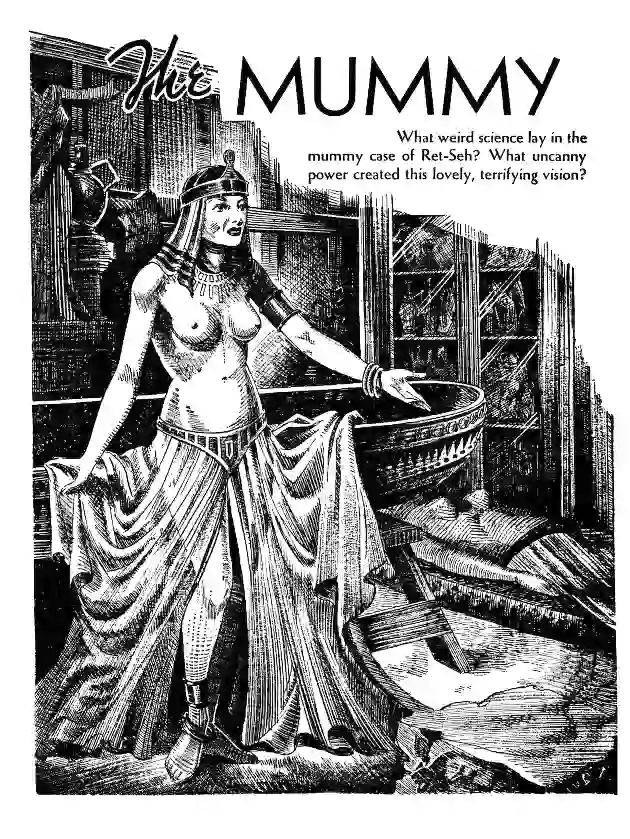

Plot Summary of "The Mummy of Ret-Seh"
When antiquarian collector Hargraves acquires what appears to be an exquisite Egyptian mummy case depicting a beautiful woman, he believes he has found the perfect addition to his private museum. The case looks well preserved, showing the figure of a scantily clad woman with an alluring face and perfect form. Yet shortly after he brings it home, strange occurrences begin, starting with the arrival of a tortoiseshell cat on his doorstep.
The Nature of the Mummy
“The Mummy of Ret-Seh” sits in the weird tale tradition. This subgenre of horror focuses on the inexplicable and cosmic rather than conventional monsters or gore. Similar to Lovecraft’s work, it proposes realities beyond human comprehension, though Verrill’s approach feels more pulpy and direct than Lovecraft’s grand philosophical style.
The tale works through the clash between rational scepticism and inexplicable events. It moves on several levels at once: a psychological horror that examines mental breakdown, a supernatural story of ancient Egyptian magic, and a reflection on the dangers of collecting objects with dark histories. Above all, it explores the violation of boundaries. The mummy case itself acts as a boundary object, designed to preserve and separate the dead from the living, yet it becomes a portal that allows the ancient to intrude upon the modern world.
The pacing builds tension through repetition and growing intensity. Each encounter with the woman or the cat becomes progressively more personal and frightening. The first appearance in the lounge feels distant and almost pleasant, while the second, in Hargraves’ bed, turns invasive and unsettling.
Verrill also uses a classic unreliable narrator structure, with the protagonist himself questioning his own perceptions. The author creates some ambiguity by offering rational explanations through Dr Gale’s diagnosis, only to undermine them with mounting physical evidence. The prose style is rather florid and melodramatic at times, but it is effective at building atmosphere. Although the writing sometimes tells rather than shows.
The decision to withhold the final truth about the mummy’s contents until after Hargraves has fled keeps the sense of horror intact.
Egyptomania
The 1930s marked a golden period for weird fiction, with writers such as H.P. Lovecraft, Robert E. Howard, and Clark Ashton Smith dominating the scene. Pulp magazines provided welcome entertainment during the Great Depression, and their lurid covers and sensational stories offered readers an escape from economic hardship.
Egyptian mummies had already been a staple of horror fiction since the nineteenth century, but they gained fresh cultural prominence after Howard Carter’s discovery of Tutankhamun’s tomb in 1922. This event triggered widespread Egyptomania across the Western world, making ancient Egypt seem exotic, mysterious, and potentially dangerous. The supposed “curse” of King Tut’s tomb, intensified by Lord Carnarvon’s death shortly after the opening, only heightened public fascination with Egyptian supernatural power
The detail that the mummy was stolen from Professor Buenaventura’s collection, with the professor found murdered and strangled, touches on concerns about the ethics of archaeological plunder and the colonial habit of removing cultural artefacts from their original homes. Although Verrill does not explore this theme, the inclusion of such a detail reveals an underlying unease about the consequences of owning sacred or stolen objects.
Author: A. Hyatt Verrill
Alpheus Hyatt Verrill was a prolific writer whose career covered natural history, archaeology, adventure fiction, and science fiction. An accomplished naturalist, inventor, and explorer, he led archaeological expeditions in Central and South America, produced numerous non-fiction works on natural history and archaeology, and held several patents. During the 1930s and 1940s he published extensively in the pulps, contributing to magazines like Argosy, Blue Book, and various Ziff-Davis publications. In many ways, he represented that generation of adventure writers who blended scholarly knowledge with popular entertainment.
My Thoughts
The story cleverly sets male desire against its own protagonist. Hargraves feels repeatedly drawn to the beauty of the mummy case and the woman who manifests from it, even as he intellectually recognises the danger. His aesthetic appreciation, along with his physical response to her appearances, creates a trap; his own attraction leaves him vulnerable to supernatural predation.
For its time, the tale also offers a modern view of mental health. Rather than simply labelling Hargraves as insane, both Doctor Gale and Professor Blackett treat his experiences as potentially psychological phenomena worthy of serious consideration. Although their rational explanations fall short, their approach reflects an era when psychology was gaining real cultural authority as a way to understand unusual experiences.
“The Mummy of Ret-Seh” recalls Edgar Allan Poe’s “Ligeia,” in which a dead woman’s spirit returns to possess another body. Both stories share an obsession with female beauty that manages to transcend death.
Wrapping Up
“The Mummy of Ret-Seh” works as entertainment and as an exploration of desire and the persistence of the past. The final revelation that the case contains a cat rather than a woman reframes every earlier encounter. There is a nice touch of irony here: the legendary sorceress who could transform into a cat to seduce her lovers was killed in feline form and preserved that way for eternity. Yet even in this reduced state, she retains enough power to reach across the millennia and terrorise a modern man through the same combination of beauty and deception that once fooled a Pharaoh.
More Fantastic adventures
Another vintage pulp magazine:
Science Wonder Stories, Vol. 1, No. 1
Science Wonder Stories, Vol. 1, No. 2
Science Wonder Stories, Vol.1, No.3
Astounding Stories of Super-Science, Vol. 1, No. 1
Original Science Wonder Stories issue at the Internet Archive.

Disclaimer: The story featured on this page is in the public domain. However, the original authorship, magazine credits, and any associated illustrations remain the property of their respective creators, illustrators and publishers. This material is provided for informational and educational purposes only and may not be used for commercial sale.