
Introduction to The Reign of The Ray... Part 2
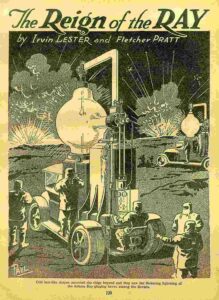
“The Reign of the Ray” by Irvin Lester and Fletcher Pratt appeared in two parts in Science Wonder Stories, with Part 1 published in June 1929 and Part 2 following in July. This ambitious pulp adventure spans continents and reimagines the nature of warfare through one groundbreaking invention. It offers an early attempt to consider how revolutionary technology might overturn traditional military power, a theme that grew increasingly relevant as the 20th century advanced.
Before you dive in, you can download the full story using the button below. If you prefer reading online, the complete text appears at the end of this page. Warning of Spoilers ahead!
Plot Summary of The Reign of The Ray
The opening instalment focuses on Robert Adams, a brilliant inventor whose creation alters world history. Adams designs a radical Coolidge tube capable of neutralising explosive materials at long range with unsettling accuracy. Once revealed, this device becomes the catalyst for a frantic global struggle. Nations manoeuvre, fleets reposition, and armies attempt to adapt as the balance of power shifts under their feet.
In the concluding part, the world confronts the consequences of Adams’s discovery. As conventional weapons fail, governments scramble for new strategies while the usual machinery of war collapses around them.
The Military Analyst as Science Fiction Writer
What makes “The Reign of the Ray” particularly significant is that it represents Pratt’s early exploration of themes that would define much of his later career. Commentators noted that Pratt possessed “excellent knowledge of warfare, and what a future war might be like,” and his fiction reflects that understanding. Pratt’s dual focus—speculative fiction and military history—often overlapped. Both fields allowed him to explore how technology shapes conflict, how strategic thinking adapts to new capabilities, and how warfare drives (or is driven by) social and political change. “The Reign of the Ray” sits at the intersection of these interests, using the speculative framework of science fiction to examine genuinely serious questions about military innovation.
The Coolidge tube that Adams invents represents a “death ray” concept that was common in early science fiction but which Pratt treats with more rigor than many contemporaries. Rather than simply using it as a plot device for adventure, Pratt considers the strategic implications: How would nations respond to a weapon that renders their existing arsenals obsolete? What happens when explosive-based warfare becomes impossible? How do military doctrines evolve—or fail to evolve—in response to revolutionary change?
History later showed that new technologies like radar, atomic bombs, jet engines, and guided missiles forced huge changes on military thinking. Pratt’s 1929 story seems surprisingly aware of this, even though his fictional “ray” never existed.
The Coolidge Tube: Technology as Disruptor
The central conceit of “The Reign of the Ray”—a device that can detonate or neutralize explosives at a distance—engages with genuine period concerns about the accelerating pace of military technology. The story appeared in 1929, barely a decade after World War I had demonstrated how rapidly technological change could make existing military paradigms obsolete.
WWI had seen the introduction of poison gas, tanks, aircraft as weapons, submarines capable of disrupting sea lanes, and industrial-scale artillery that could pulverize landscapes. The lesson was clear: technological innovation could swing the balance of power overnight, and failure to anticipate or respond to such innovations could mean a catastrophe.
The Obsolescence of War Itself?
The horrific scale of the First World War inspired movements for disarmament and international cooperation. The League of Nations, founded in 1920, represented an attempt to prevent future wars through diplomacy rather than force. Yet many observers feared that new technologies would continue increasing destructive potential. Treaties such as the Washington Naval Treaty of 1922 tried to limit armaments, but theorists were already imagining future weapons—strategic bombers, chemical attacks, perhaps even atomic power—that could render those agreements meaningless.
Ironically, Pratt’s story ends with soldiers fighting with “stones and sticks” once explosives cease to function. It’s a darkly humorous twist that highlights the fragility of advanced warfare.
Author: Fletcher Pratt
Although credited to Irvin Lester and Fletcher Pratt, the story was written solely by Pratt using his Lester pseudonym. His first published tale, “The Octopus Cycle,” appeared in May 1928. Murray Fletcher Pratt (1897–1956) was born near Tonawanda, New York, and studied briefly at Hobart College before financial difficulties forced him to leave. He later worked as a journalist for the Buffalo Courier-Express and moved to New York City in 1920. Pratt married Inga Stephens, a professional illustrator, in 1926.
His introduction to science fiction came through translating and writing for Hugo Gernsback’s Science Wonder Stories. During the Second World War, Pratt served as a military analyst for the New York Post and Time, and he later became a respected reviewer of history and speculative fiction for the New York Times Book Review.
My Thoughts
To me, “The Reign of the Ray” reads like an early form of the modern techno-thriller or near-future military SF. These stories take existing military ideas, extend them slightly, and explore the political and strategic fallout. This serial is quite long—two instalments—and most of the exciting material appears in the first. Even so, the sheer number of characters creates a sense of scale. Following what each individual contributes feels genuinely rewarding, as every decision drives the wider conflict.
Written between the world wars, the story captures a moment of uncertainty. Nobody knew which direction military technology would take, and some people even hoped that future inventions might enforce peace rather than fuel conflict. Through scenes of tension, hope, and international desperation, Pratt paints a picture of a world standing at a turning point. I genuinely enjoyed reading it.
Wrapping Up
Nearly a century later, humanity continues to wrestle with disruptive military technologies (autonomous weapons, cyber warfare, orbital systems) and their strategic consequences. Pratt’s 1929 serial feels surprisingly relevant in that context. His exploration of revolutionary weapons and their impact on international relations still resonates today.
For readers interested in the origins of military science fiction, the evolution of strategic thinking, or imaginative speculation about the future of warfare, “The Reign of the Ray” remains an engaging and thoughtful piece of early genre history.
Other stories from Science Wonder Stories, Vol 1, N° 2
More early tales with warfare theme:
Another vintage pulp magazine:
Science Wonder Stories, Vol. 1, No. 2
Science Wonder Stories, Vol. 1, No. 3
Astounding Stories of Super-Science, Vol. 1, No. 1
Dynamic Science Fiction Vol. 1, No. 1
Original Science Wonder Stories issues at the Internet Archive.
Disclaimer: The story featured on this page is in the public domain. However, the original authorship, magazine credits, and any associated illustrations remain the property of their respective creators, illustrators and publishers. This material is provided for informational and educational purposes only and may not be used for commercial sale.