
Introduction
“X for Expendable,” penned by William C. Bailey, launched in Dynamic Sciences Fiction Vol. 1, No. 1. It delivers a potent blend of atomic-age anxieties and hard-boiled detective action, immersing the reader in the gritty, high-stakes world of 1950s pulp science fiction. Ultimately, the narrative functions as an action-driven exploration of a simple premise: and the government expending a million credits to save the world.
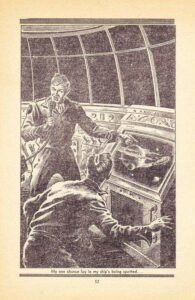

Plot Summary of "X for Expandable"
Brad Raynor (X-3206) is a rookie “Expendable” agent for the IPO (Interplanetary Police Organisation)—an operative with summary powers to requisition anything in service of preventing atomic war. Two weeks into his first assignment with the Cadmium Unit, he clashes with his boss, Foran, who runs a tight yet complacent operation. Crucially, Brad discovers that Haverford International has been shipping cadmium bars—critical for nuclear dampers—to suspicious companies without the required reports.
The Expendable Philosophy
The story’s title and Brad’s classification reveal its central concept: “X” stands for “expendable,” denoting agents who are expected to be used up in service. The IPO needs operatives willing to take massive risks, make independent decisions, and potentially die to prevent catastrophe. Brad chose this classification deliberately: “I’m a big strong ape… I figured I might bull my way through a few big plays before I get old and slow.” In essence, he is gambling his youth and life for rapid career advancement—to die young as a hero or survive to secure a prestigious post while young enough to enjoy it. By the story’s end, however, Brad’s profound exhaustion suggests the true cost of being expendable; he has burned through his optimism, idealism, and innocence.
Procedural Elements
“X for Expendable” is space-age noir detective fiction. Bailey includes classic procedural beats: following the money trail from cadmium shipments to dummy companies; meeting an informant (Seeley at Haverford, who provides leads under duress); visiting a seedy bar, Merino’s Dugout, as a front for criminal operations; and a thrilling chase across the solar system with multiple fights and shootouts. The narrative concludes with a twist where the uranium pile’s location is finally discovered.
That said, Bailey transposes these elements into a 32nd-century setting: retinal pattern ID replaces fingerprints, encephalscopes (brain-wave trackers) stand in for bloodhounds, agents requisition spaceships instead of commandeering cars, and they skywrite distress signals with rocket exhaust rather than sending radio calls. This procedural framework makes the exotic setting comprehensible; we follow Brad’s investigation because it adheres to a familiar detective-story logic—just furnished with atomic-age props.
Bailey employs a spiral structure, where each revelation expands the investigation’s scope and raises the stakes. What begins as a routine check evolves into a desperate race to prevent a nuclear catastrophe—a normal day in the pulp world. This relentless escalation maintains tension while introducing progressively more exotic locations. Once Brad leaves Earth, the story barely pauses, unfolding as a breathless sequence of chase, confrontation, escape, pursuit, crash-landing, and rescue, interrupted only by essential exposition.
Cold War Pulp
In essence, “X for Expendable” distils pure Cold War concerns into an adventure story. With the Soviet Union possessing atomic weapons and hydrogen bomb research advancing, nuclear proliferation seemed an inevitable and terrifying prospect. Against this backdrop, the IPO represents a fantasy of enforceable disarmament, where the good chaps can actually prevent apocalypse. Bailey writes in the lineage of Doc Savage—the super-competent hero with summary powers saving the world—melded with the hard-boiled detective tradition.
Author: William C. Bailey
Regrettably, very little biographical information about William C. Bailey appears to be available. He seems to be a typical one-story author or perhaps wrote under various pseudonyms. “X for Expendable” may be his only science fiction publication, or one of very few.
The story’s detailed rocket-flight sequences will thrill some readers and bore others. Bailey clearly knows—or convincingly fakes—technical details like catalyst plates, cowl-flaps, and ram-air ratios. This verisimilitude serves the story’s realism; the conspiracy works precisely because its technical details feel plausible. Moreover, Bailey writes in a classic 1950s pulp style—economical, action-oriented, and heavy on simile—demonstrating a confident and competent handling of the genre.
My Thoughts
Bailey’s universe is neither a utopia nor a dystopia; it is more akin to a pragmatic tragedy. Systems work imperfectly, people sacrifice incompletely, and victory costs more than it should. Yet civilisation continues. We have seen what happens when security services are given unlimited power, and we know institutional authority doesn’t guarantee competence or morality. Nevertheless, who pays to keep civilisation functioning? How much should they pay? And when is the price too high? Perhaps this ambiguity is the story’s real achievement: it shows us both why we need Expendables, and why being expendable destroys you.
This tension reflects the 1952 Cold War mentality—the notion that we can win, but winning costs everything. The atomic threat is real; preventing it requires sacrifice; and those who sacrifice are used up.
The story’s universe feels oddly depopulated. Brad interacts with perhaps a dozen characters in total. Locations like Jupiter, Europa, and the asteroids are mentioned as having minimal inhabitants. Also absent is any personal life for Brad—no family, friends, or romantic interests are noted. He is a pure professional, which suits the noir tradition of the lone detective but also renders him an incomplete figure.
Wrapping Up
“X for Expendable” is an effective pulp adventure with surprising thematic depth. On the surface, it is a tale of a tough chap saving the world from a nuclear conspiracy. Underneath, it is a meditation on what civilisation costs those who protect it. Brad succeeds—he stops the bomb and saves billions of lives. Yet victory consumes him: he has killed two men, watched his companion die, spent over a million credits, and nearly died multiple times. He returns exhausted, disillusioned, and drinking alone. Civilisation, it seems, requires expendables—people willing to be used up in its service.
In the end, “X” stands for the variables we sacrifice to solve civilisation’s most dire equations.
More of Dynamic Science Fiction Vol.1, No.1
Another vintage pulp magazine:
Science Wonder Stories, Vol. 1, No. 2
Science Wonder Stories, Vol. 1, No. 3
Astounding Stories of Super-Science, Vol. 1, No. 1
Dynamic Science Fiction Vol. 1, No. 1
Original Original Dynamic Science Fiction issue at the Internet Archive.
Disclaimer: The story featured on this page is in the public domain. However, the original authorship, magazine credits, and any associated illustrations remain the property of their respective creators, illustrators and publishers. This material is provided for informational and educational purposes only and may not be used for commercial sale.