The Thing: The Pinnacle of Sci-Fi Horror
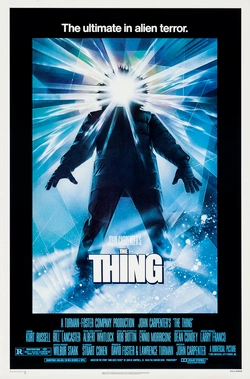
There are films that find immediate success and end up forgotten years later. Others travel the opposite path: they are misunderstood at their launch but gradually win recognition until they become absolute classics. Nowadays, however, when one talks about great horror and science fiction films, few titles manage to gather as much praise as The Thing.
Directed by John Carpenter and released in 1982, the film is today considered one of the greatest works of horror and science fiction ever produced. I’m including myself in that group too. The Thing is certainly my favourite horror film and it is almost difficult to write how much I like it. Its combination of psychological suspense, body horror, absurd special effects and a narrative based on mistrust, and on an incredible creature, continues to influence filmmakers more than forty years after its debut.
The recognition that the film possesses currently did not happen straight away. At its launch, The Thing divided opinions between critics and the public, but as the decades passed it was rediscovered by new generations and passed to be considered one of the greatest masterpieces of horror ever produced.
Plot Overview
The plot takes place in a research station in Antarctica, where a group of scientists finds an extraterrestrial life form capable of assimilating and copying any living organism. From that moment on, the main conflict of the narrative arises: nobody knows who continues to be human.
Minor Spoilers Ahead!
Paranoia in the Antarctic Ice
The film is based on the novella Who Goes There?, published in 1938 by John W. Campbell Jr. The story was published for the first time in the magazine Astounding Science Fiction, and the story is very similar, including the outpost in Antarctica and the shapeshifting monsters. Although the premise seems simple, the script uses this idea in a brilliant way. The spectator is placed in the same position as the protagonists, trying to find out who can still be trusted.
Now, even if this premise looks brilliant today, back there in 1982 the public was not prepared for the pessimism and the graphic violence presented by Carpenter. The launch occurred a few weeks after the phenomenon of E.T. the Extra-Terrestrial, a film that portrays aliens as friendly and moving beings. Whilst Steven Spielberg presented an optimistic vision of extraterrestrial contact, Carpenter showed exactly the opposite: a monstrous entity that is impossible to comprehend. I believe that this difference helped to explain the chilly reception that the film received initially.
The Thing Itself
The alien created by John Carpenter and Rob Bottin is a jaw-dropping thing that deserves to be eternalised. Perhaps it is my favourite cinema monster, the list is long. It does not possess a defined shape, it has no recognisable face and it cannot be defeated simply with courage or physical strength. Its nature is incomprehensible and its great weapon is the ability to completely destroy the trust between people.
What we see of the creature during the film are just temporary stages of its transformations. The spectator never knows what its next shape will be, what its capabilities are or where its ability to adapt ends. I still think it is curious to think about the question of the clothes, but that is a conversation for another time.
Another aspect that usually generates debates is the lack of information about the creature. The film provides only the bare minimum necessary to comprehend the threat. We do not know exactly where it came from and we do not completely understand its motivations. And we do not know its biological limits either. Albeit I bet on the fact that it just wants to survive and feed.
Throughout the film, the creature transforms each character into a possible suspect, which is the main motif of the plot. What matters is the question of who will be the creature at the moment. And, as the characters realise the extent of the threat, they begin to mistrust one another. Part of what makes a horror really good is involving the imagination of the spectator in the events: letting the spectator mistrust, letting the spectator elaborate in their own mind where the creature is, what it is doing and so on.
The imagination manages to be more terrible than any image that you put on screen. When the characters walk through the corridors of the station, the spectator does not know who is contaminated. When someone disappears for a few minutes, the doubt arises immediately.
It is a very inevitable creature.
Special Effects: Why Rob Bottin’s Work Never Gets Dated
If there is an element that helped to eternalise The Thing, it is certainly its practical special effects. Created by Rob Bottin, the effects continue to be impressive even after more than forty years. Instead of relying on computer graphics, the film uses prosthetics, animatronics, makeup and mechanical mechanisms to give life to the grotesque transformations of the creature.
Many scenes continue to shock spectators precisely because they possess an appearance that is not realistic, but palpable, something that is frequently lacking in productions excessively dependent on digital effects.
It is no exaggeration to state that The Thing represents one of the highest points in the history of practical special effects in cinema.
I imagine that, if for me, accustomed to all types of top-notch special effects and computer graphics, the film is absurdly spectacular, I find myself trying to convince the people in that period watching this for the first time. There is a physical quality to the transformations that many digital effects still have difficulty reproducing. Again, it is not real, and you realise that it is a puppet made of plastic and heaven knows what else, but it occupies a physical space in the world, it is present on the filming set.
As they do not depend on digital renders that age with the advance of technology, however unreal it seems, it does not get dated. You can still notice the imperfections, you can touch it, you can feel the weight that it exerts. In other words, it may not be a realistic scary monster, but it is truly a scary puppet monster.
Body Horror
The body horror is a subgenre of horror that explores the transformation, deformation or destruction of the human body. The body horror transforms the body itself into a source of fear—the pinnacle of this genre can be seen in the film The Fly, in my opinion.
The body is a sacred thing for the human being and any notion of violating it is tremendously agonising for us. More than two arms on the body, the skin breaking open, the shape of the face, the body unrecognisable, all of this can be a source of discomfort. This type of horror works because our perception of identity is intimately linked to the body. When we see these structures being distorted in an extreme manner, we feel discomfort at an instinctive level.
And the creature has a very curious thing in its transformations where it does not totally lose the human aspect, which stays mixed with its more alien shape.
Although it possesses its own identity, the visual of The Thing dialogues with some important trends of the horror of the era.
There is a clear conceptual proximity to the works of the Swiss artist H. R. Giger, creator of the biomechanical aesthetic of Alien.
At the same time, the film shares elements with the cinema of David Cronenberg, a director known for exploring bodily mutations in works like Videodrome and The Fly, already cited.
The Cinematography of Isolation
John Carpenter is a great director, there are no doubts as to that. Here in The Thing, he uses framing, lighting, visual composition and camera movements to build a sensation of discomfort. Even before the creature appears in its monstrous shape, the film is already bothering the spectator through its visual language.
To begin with, this is done using the contrast between the great white ocean that is Antarctica against the small black dot that is the station.
Antarctica is used in an intelligent manner to increase the sensation of vulnerability. The frozen and desolate setting transmits the impression that there is no possibility of external help. Right in the first scenes, the cinematography highlights huge expanses of snow that seem to prolong themselves infinitely. But, the sensation is one of total abandonment. The characters are completely isolated from the rest of the world. This hostile environment transforms the research station into a true prison. The more the threat spreads, the more suffocating the situation becomes.
I think that is fantastic; as the situation worsens, the place passes to transmit a growing sensation of claustrophobia, even though it is located in one of the most open spaces on the planet.
A large part of the film happens inside narrow corridors, laboratories, dormitories and maintenance rooms. The cinematography frequently uses framing that makes the characters look trapped inside the scenery.
In many moments, Carpenter uses compositions that show several members of the team at the same time. The director wants the spectator to observe all the characters simultaneously. As the creature is among them, the film gains more with them in the same room, instead of alone and vulnerable, like in Alien, for example.
The film is also slow, there are no exaggerated or super-elaborated camera movements. John Carpenter dedicates a lot of time to the construction of the atmosphere, to the dialogues and to the growing mistrust between the characters. Again with the intention of letting the paranoia aspect dominate instead of a surge of action, which is saved up for the end.
Ennio Morricone’s Soundtrack
The soundtrack was composed by the legendary Ennio Morricone, known for his works in classic westerns. The music works almost like a sombre heartbeat that accompanies the deterioration of the situation. It is a minimalist and repetitive theme with a lot of tension, as well as being short, which generates a sensation of interruption. The music does not generate a climax, nor an escape from the situation. Obviously, what this creates in the spectator is anxiety, anticipation, the sensation of being suppressed and uncomfortable.
Does The Thing Have Any Weak Points?
Talking about the defects of The Thing can seem strange, considering the almost mythical status that the film won over the decades. For me, this search for weak points is not something that pleases me very much, mainly when the experience as a whole is good and functional. But, for the entertainment, we are here looking for some.
Perhaps the most recurrent criticism of the film is related to the development of its characters. The research station is composed of various scientists, mechanics and pilots, but few receive enough time for the public to know their stories or personalities deeply. The more characters, the less development time, simple as that. Monster films usually suffer from this bad, since we need a good amount of characters to be devoured by the creature. Perhaps Jaws is a counter-example, but anyway.
MacReady, played by Kurt Russell, is clearly the protagonist. However, several members of the team end up being remembered more for their functions in the plot than for striking individual characteristics. Of course, the creature is the star of the work. In comparison with films like Alien (1979), where each member of the Nostromo possesses a well-defined identity, some characters in The Thing can seem difficult to distinguish, or remember.
Curiosities
The film was a commercial flop
Today considered a classic, The Thing grossed less than expected at its launch. Many experts believe that competition with more optimistic films of the time harmed its reception.
Inspired by a literary work
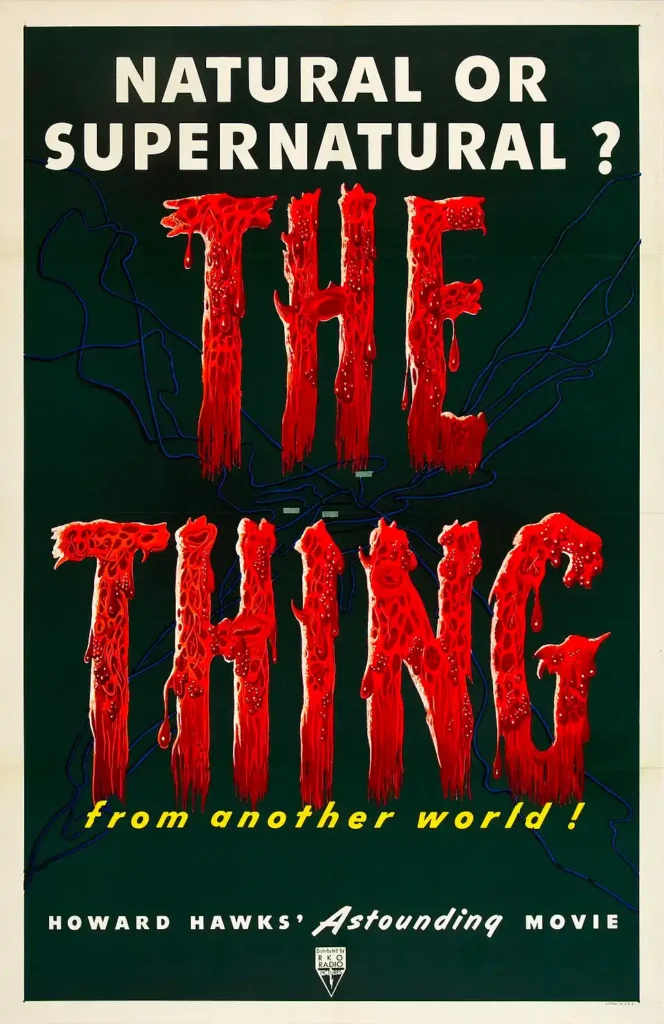
The film is based on the novella Who Goes There?, published in 1938 by John W. Campbell Jr. The story had already received a cinematographic adaptation in 1951, entitled The Thing from Another World.
Does the creature lose its importance in the story?
Yes, this is a subject raised by those who speak about the film: the fact that part of the second act is more focused on the paranoia of the characters and not on the creature, even though it is the catalyst of that paranoia. Really, in a good part of the film, the creature practically disappears from the visual narrative.
Wrapping Up
The Thing is still an almost perfect example of how to build tension, fear and suspense. Its intelligent script, convincing characters, its suffocating atmosphere and its extraordinary special effects make it an essential work for any lover of cinema.
In the end, the true horror of The Thing is in the doubt that remains when the credits roll, in the sensation that we cannot always trust our own eyes and in the uncomfortable certainty that some monsters are scarier precisely because they can be hidden behind a familiar face.