Everyone Says Citizen Kane Is the Greatest Film Ever Made. They're Right.
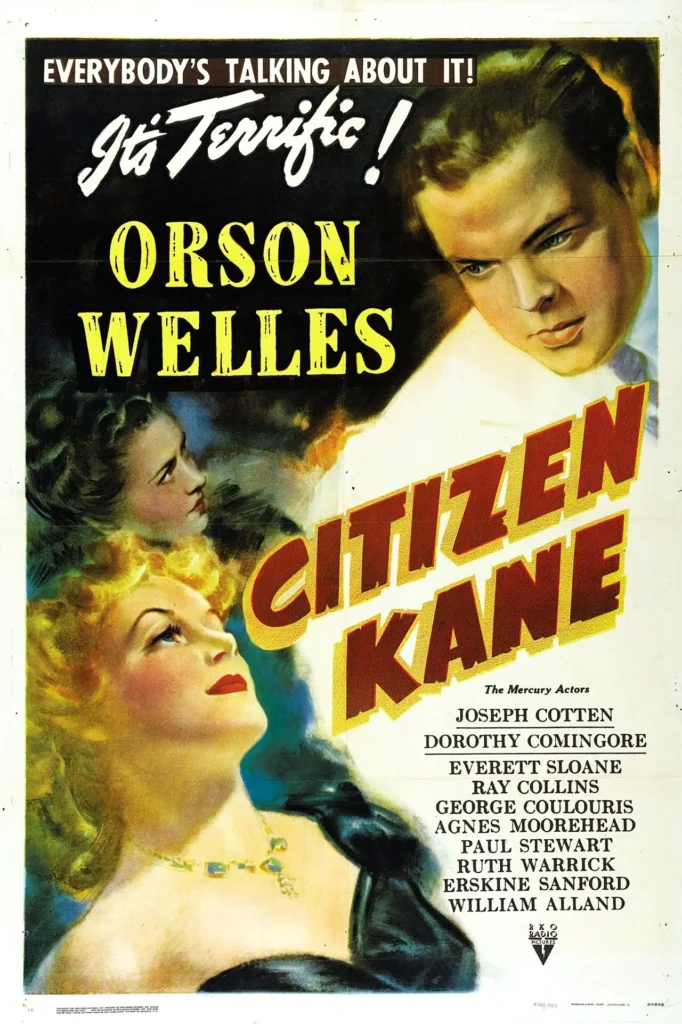
I know people say this all the time, but Citizen Kane is the greatest film ever made, and I need to say it here as well. On my personal list of the best films in cinema, this sits firmly in first place. Some films are huge successes in their own time and end up forgotten. Others become classics. Then there are those rare titles that change the very language of cinema itself. Citizen Kane belongs to that last category.
Released in 1941 and directed by Orson Welles, the film transformed cinematic language by introducing innovative techniques in storytelling, cinematography and editing. Beyond its technical achievements, it also offers a thoughtful examination of power, ambition, loneliness, and the search for happiness, or perhaps for something we lost long ago.
But the big question remains: does Citizen Kane still deserve all the praise it receives more than eighty years after its release?
The short answer is yes.
Plot Overview
The story of Citizen Kane begins with the death of Charles Foster Kane and his mysterious final word: “Rosebud”. From there, his life is reconstructed after his death through interviews and accounts from people who played a part in it. The narrative does not follow a traditional chronological order and instead uses multiple perspectives to gradually uncover the protagonist’s complex personality.
Citizen Kane Narrative
Instead of following a conventional timeline, the film presents fragments of Kane’s life through multiple perspectives. That narrative structure may seem commonplace today, but it was far less common at the time, when cinema was still closely tied to theatrical drama. Here, each character offers their own interpretation of events, making the audience an active participant in piecing together the story. There is no absolute truth about Kane. There is only a collection of memories, opinions and experiences that help shape our understanding of him.
Throughout the film, we follow his rise to power and his transformation into one of the most influential figures in the country. Yet as his empire expands, his personal relationships begin to fall apart. Friends drift away, marriages collapse, and happiness seems to move further out of reach.
The fragmented narrative, built through multiple viewpoints, keeps the audience engaged even though we know from the beginning how the protagonist’s story will end. Each testimony adds another layer to Kane’s personality, making it impossible to define him in simple terms.
Who Is Charles Foster Kane?
Kane is easily the best thing about the film, and much of that comes from how his story is constructed. We never truly know the real Charles, and we never see events from his point of view, despite him being the protagonist. It’s an astonishingly clever idea, something you often find in the work of Leo Tolstoy.
Thompson interviews five people who were crucial figures in Kane’s life:
Walter Thatcher, Kane’s strict and conservative legal guardian, as well as a wealthy financier.
Mr Bernstein, a loyal associate who helps Kane build his media empire and later serves as the newspaper’s general manager.
Jed Leland, Kane’s lifelong best friend and former university roommate.
Susan Alexander, Kane’s second wife. An amateur opera singer whom Kane unsuccessfully attempts to turn into a famous diva.
Raymond, Kane’s butler and the administrator of his mansion, Xanadu.
Each of these characters presents their own version of Kane. The flashbacks we see are not objective truth, nor are they Kane’s perspective. They are filtered memories shaped by each narrator’s personal perception. We never receive a flashback from Kane himself. He is the only major character who never tells his own version of events.
Kane is a character whose inner life remains inaccessible throughout the film. Everything we learn about him comes from the outside. This creates a powerful sense of mystery and distance, much like what Tolstoy does with Anna Karenina at key moments in the novel.
The narrative method of Citizen Kane works as a cinematic equivalent of Tolstoy’s polyphonic technique. Instead of relying on an omniscient literary narrator, Welles and Mankiewicz use a reporter gathering subjective accounts. Just as Tolstoy presents Anna through the judgement, passion and misunderstanding of those around her, Citizen Kane presents Charles Foster Kane as an unsolvable puzzle whose true essence, “Rosebud”, remains beyond anyone’s grasp.
His official biography is that of a newspaper tycoon, owner of an empire of newspapers, radio stations and shipping companies, an unsuccessful candidate for governor, and the builder of an empty palace called Xanadu. His real biography, however, is that of a collector of objects and people who spent his life trying to fill a void contained within a single word: Rosebud.
Cinematography
From a technical standpoint, Citizen Kane introduced innovations that influenced generations of filmmakers. I mean, the film still looks impressive today. Gregg Toland’s cinematography is often cited as one of the finest in cinema history, and it’s easy to see why.
Deep Focus: Seeing Everything, Feeling the Isolation
At its simplest, we’re talking about the use of deep focus, the technique that made the film’s cinematography so famous. Deep focus creates richly detailed images, allowing different elements within a scene to remain sharp at the same time. Today that may not sound particularly impressive, of course. But consider that classical Hollywood cinema usually focused on whichever actor was speaking, leaving everything else blurred. Toland allows the audience to decide where to look, or to take in the entire image at once.
That approach creates additional meaning through visual composition. A character can be placed far in the background to highlight their emotional distance, for example. It also allows for more stylish and expressive framing.
Previously, scenes often resembled a stage play, with two characters sharing the foreground while the set sat behind them. Now you could have one character standing close to the camera while another remained much further away, making the scene feel more natural and dynamic.
Low-Angle Shots and Ceilings
Welles and Toland broke one of classical cinema’s unwritten rules: never show the ceiling. Studios avoided ceilings because they interfered with lighting and reminded viewers they were looking at a set.
At first, showing ceilings simply adds realism, since most of us spend our lives beneath one. Yet ceilings also play an important role in composition. In some scenes, the camera angle elevates Charles Kane and the world around him, with towering ceilings and magnificent interiors. In others, it works against him. Vast spaces seem to crush him. He becomes tiny within the frame while the world around him feels overwhelmingly large. The ceiling almost turns into the roof of a cave.
Expressionist Lighting
Like many films of its era, Citizen Kane draws heavily from German Expressionism (The Cabinet of Dr. Caligari, Nosferatu) and from the film noir style that was beginning to take shape.
Harsh light and sharp shadows dominate the frame. Faces are often only partially illuminated, especially Kane’s. One eye remains in the light, the other in darkness: the idealist and the tyrant, the public figure and the private ghost.
In painting, this technique was known as chiaroscuro and was popularised by names as Caravaggio. The image is divided into areas of light and darkness. Most visual information sits within the illuminated section, while the darker areas remain hidden from view. It is an effective technique because it guides attention, creates immediate contrast, helps define form, which is essential in more complex compositions, and adds a sense of ambiguity and mystery.
Problems with Audience Identification
As mentioned earlier, Citizen Kane, despite its countless strengths, features a protagonist who is not especially relatable from a narrative standpoint. In truth, very few of the characters are. Even the reporter occupies a largely functional role. In theory, we should share his curiosity about the investigation, yet he appears only briefly and is almost always shown from behind.
Our entire relationship with Kane is mediated through other people, and we already know what will happen to him. For some viewers, that can create emotional distance and make it harder to become invested. It wasn’t my experience, but I can certainly understand why others might feel that way.
As a result, the film relies heavily on the quality of its screenplay and its technical craftsmanship, including the performances.
Controversies
Although it was never officially presented as a biography, many elements of the story closely resemble the life of William Randolph Hearst, one of the most powerful figures in American journalism. The connection between Kane and Hearst generated considerable controversy.
Hearst used his influence in an attempt to block the film’s distribution and prevent his newspapers from mentioning it.
Wrapping Up
More than eight decades after its release, Citizen Kane remains a fundamental reference point in film studies and, yes, it is one of the finest films I have ever seen. Its aesthetic innovation, narrative complexity, unforgettable central character and timeless themes continue to attract the attention of critics, scholars and audiences alike.
The film shows how cinema can move beyond entertainment and become a powerful tool for examining the human condition, securing its place among the most important works in the history of film.