The Dawn of the Alien Invasion
“Spawn of the Star” is a short story written by Charles Willard Diffin and published in Astounding Stories of Super Science in 1930. Diffin gives us another encounter with aliens in an apocalyptic invasion; a type of story that was thoroughly explored in the early days of science fiction. It’s an action-heavy narrative with moments of optimism and pessimism, alongside some interesting points to think about.
The complete PDF of this public domain edition is available for download at the end of this article.
For more pulp stories, click here.
Plot Summary of "Spawn of the Star"
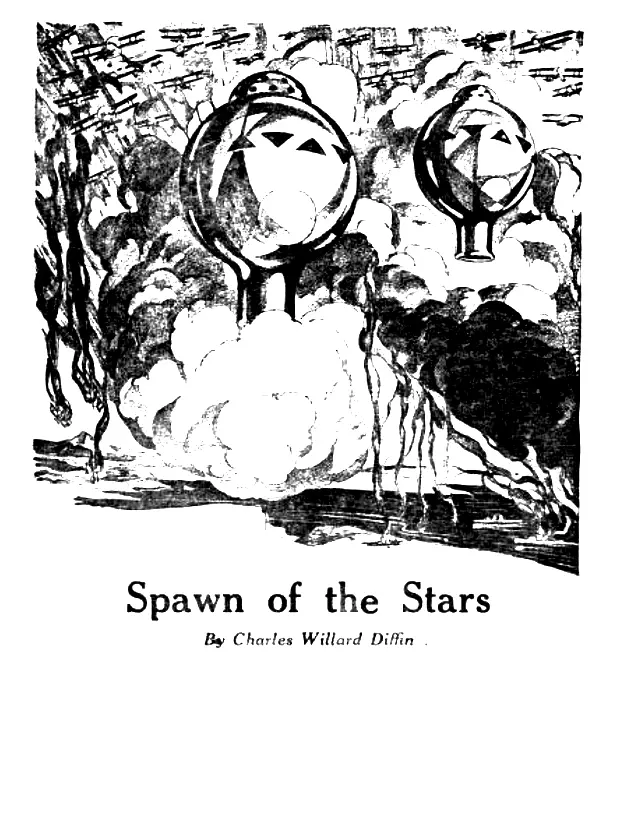
A wealthy sportsman and his irreverent pilot make a forced desert landing and encounter something that should not exist: a vast, formless, protoplasmic creature emerging from a gleaming metal sphere to feed on cattle under the Arizona stars. What begins as a private nightmare quickly engulfs the world.
Spoilers Ahead!!!
Alien Invasion…. again
This story is a straightforward alien invasion, a very common genre at the start of science fiction. However, what makes it interesting is how it handles the link between “knowing” about something and “being able to do something about it”. In this case, understanding the threat isn’t the same as being able to stop it.
First, let’s talk about the encounter; the meeting with the alien is good—really good, actually. The alien figure is scary and is introduced with quite an impact right at the start of the tale. After that, the world falls into chaos, with tragedy after tragedy carried out by these creatures from another world.
Another feature of this story is the way it rotates “heroes”, which wasn’t unusual in certain pulp stories with an epic quality; although it isn’t exactly the same, The Reign of the Ray is an example of this. In these tales, the author spends several chapters just describing the total destruction of the world, or part of it, as if this were a massive draw for readers; perhaps it was at the time. After all, disaster films still make a mint today.
The aliens’ weakness this time is hydrogen. Yes, the simplest and most basic element in the universe, I think!. According to MacGregor, they use hydrogen kept in a state of partial decomposition (good grief!). In other words, the aliens use hydrogen for everything; fuel, weapons, and in the end, it even serves as their weakness.
So, as you can tell, nothing here is a million miles away from what we expect from something like “Independence Day”.
Military Technology Fixation
“Spawn of the Star” is a classic example of the stories found in pulp magazines of that era; full of action, danger, and global destruction, various characters, and a total obsession with military gear. You wouldn’t believe how much these blokes loved military tech.
Much of this fixation with the military world was obviously a result of the Great War. We’re talking about people who lived through aerial bombings, gas attacks, and a death toll never before imagined. The text portrays the feelings and experiences of that time. Human effort seems tiny in the face of such madness.
Now, Americans had a great deal of confidence—perhaps misplaced, perhaps arrogant—in their own institutions. They always pushed that heroic vision of their military, with top-of-the-line planes and handsome pilots ready to make the ultimate sacrifice. It’s a recurring element of the pulps, describing this American bravery and power. Honestly, it’s quite fun, even if that power isn’t enough to stop the invaders here.
Author: Charles Willard Diffin
Charles Willard Diffin (1884–1966) was an American engineer and prolific contributor to the early science fiction pulps, publishing dozens of stories in Amazing Stories and Astounding Stories throughout the late 1920s and 1930s. He came from a technical background, and his stories share that era’s “faith” that engineering and applied science are humanity’s best tools against any problem.
My Thoughts
What makes this story a bit of a head-scratcher is that it’s optimistic on the outside and pessimistic on the inside. On the surface, it’s all adventure, planes, troops, and things blowing up. Underneath, it shows that all this military polish is useless. The only way out is to die fighting. And in 1930, with the First World War still fresh in the memory, that must have hit differently. Mind you, I don’t know how optimistic America really was after the conflict, seeing as they hit the Great Depression during the 30s.
One curious thing is that the army is simply shredded by the enemy, so even that sense of wonder I mentioned earlier can be questioned. The pilots die trying, the soldiers die trying, and it’s no use. Only science and the individual skill of one man make any difference. It’s a slightly bitter view of what actually wins the day.
The aliens’ weakness feels very “War of the Worlds ending”. The aliens need a flaw to end the conflict; otherwise, they’d take over everything with their tech.
Wrapping Up
“Spawn of the Star” is a great story, even if you can see what’s coming. It still has its merits. Of course, it can’t compete with the daddy of all alien invasions, War of the Worlds, but it has its own charm and its own ideas. It deserves to be remembered and read, and who knows, maybe turned into another yearly “end of the world” film. Anyway, I’ll let MacGregor have the final word: “I believe we are witnessing the end of the world…” “But we can die fighting.”
This work was originally published in 1930 and is in the public domain according to current legislation. However, the original authorship, magazine credits, and any associated illustrations remain the property of their respective creators, illustrators and publishers. This material is provided for informational and educational purposes only and may not be used for commercial sale.
More of Astounding Stories of Super Science
Spawn of The Star – Charles Willard Diffin (Astounding Stories of Super Science, Vol. 01, No. 2)