Atomic New Age

The Outsider by H.P. Lovecraft: Review and PDF

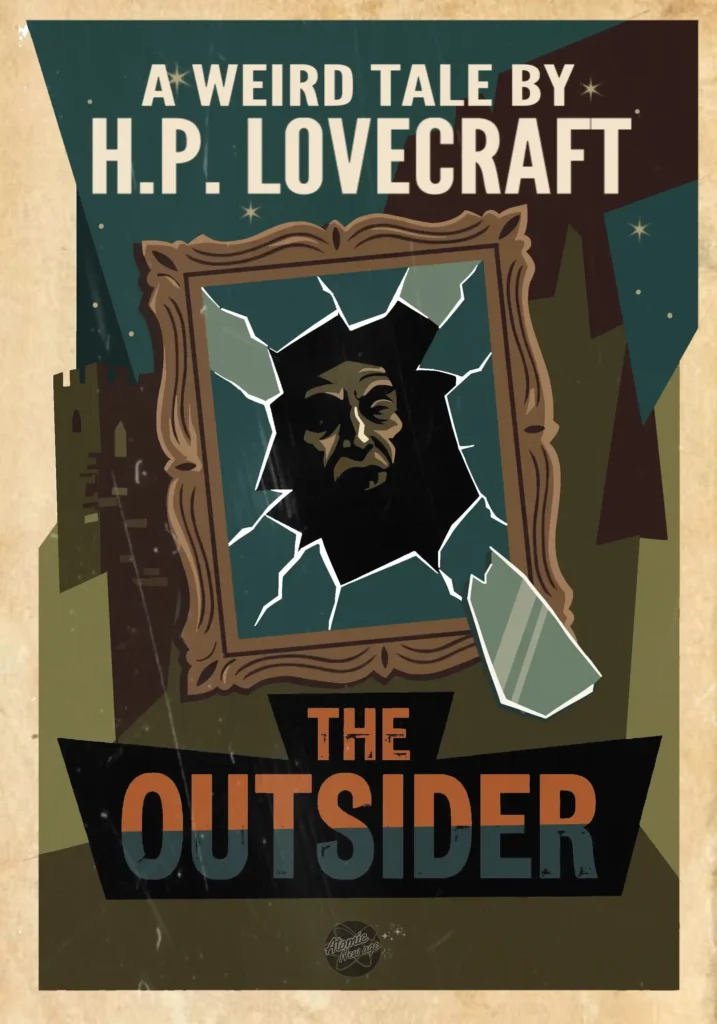
Cover of The Outsider by H.P. Lovecraft

Title: The Outsider 


Author: H.P. Lovecraft


Original Publication: Weird Tales (Vol. 7, No. 4)


Release Date: April, 1926


Editor: Farnsworth Wright 


Publisher:  (Popular Fiction Publishing)


Illustration: Yan Viana


Genre / Subgenres: Horror / Gothic Horror / Weird Fiction


Copyright Status: Public Domain (Free Download Available)


Format & Availability: Article Review + Complete PDF Edition

The complete text of “The Outsider” and its free PDF version are available at the bottom of this article. Click here to skip to the download section.

The Outsider is a short story written by H.P. Lovecraft around 1921 and published in Weird Tales in 1926, at the request of colleagues who convinced him to submit his work to the magazine. It is one of his fable-like fantasy stories. The tale belongs to what is known as his “poetic” or “Gothic” period and, like most of these stories, takes place in the strange Dreamlands. Numerous critics praise this piece of the author’s work, referring to it as his finest work. It’s no wonder that it is frequently read as an entry point into Lovecraft’s work and as an example of his “poetic” style. Curiously, Lovecraft himself regarded the story as excessively mechanical, with somewhat flowery language.

Keep reading if you want a more detailed review with spoilers, or skip to the bottom of the page to download the full text and read it yourself.

Complete H.P. Lovecraft List of Stories by Releasing Date

Plot of "The Outsider"

An unnamed narrator, with no memories of his past, lives alone in an ancient, dark and damp castle, surrounded by enormous trees that block out the sunlight. He has never seen another human being, has never heard a voice (not even his own), and has learnt everything from mouldy books. His only desire is to see the light, the sky and the world he reads about in their pages. Determined to die trying, he climbs a ruined black tower that rises above the forest.

Gothic Horror, Isolation and Lovecraft's Style

The Outsider is a mysterious first-person narrative that uses this element to its advantage, establishing the final surprise in store for us. The narrator doesn’t know who he is, and this limits our knowledge. The reader discovers the truth alongside him, or perhaps a little earlier. The character, Gothic as he is, adopts a confessional and poetic tone, lamenting his own condition. The setting, to me, is somewhat confusing, as is everything in the Dreamlands, and it’s a Gothic pastiche: dampness, the smell of the dead, cobwebs and perpetual darkness. The narrator, however, does not suffer too much on account of this. He considers skeletons “more natural” than the images of living beings in books.

Lovecraft was an avowed fan of Edgar Allan Poe, and you’ll often see Poe mentioned when discussing this period of the author’s work, when Gothic fiction had a very strong presence. Lovecraft himself considered The Outsider his closest attempt at writing a Poe tale. The story makes use of the frightening figure of the “monster”, something we have already seen in Frankenstein, which generally represents social alienation or the tortured, lonely figure. The same type of narrative appears in The Phantom of the Opera, which, would you believe it, is also a Gothic work.

Upon discovering the world outside his darkness, the narrator finds himself lonelier than before, as he now knows that people have companionship, yet he has been excluded from it. Previously, he’d only known about such things through books. The interesting thing about this story is that we finally get to see the monster’s perspective. Previously, the monster had only been represented through vague descriptions and ideas; this time, he is the one telling his story. This is still unsettling, as the author keeps him sufficiently “hidden” for us to feel his sorrow, whilst he remains distant and frightening.

Characters and Setting

Narrator: The character who recounts his own story. We later discover that he is a solitary ghoul who fled the Nile Valley, where he lived with others of his kind, but has since forgotten his past.

Castle: The story begins in the ruins of what appears to be an ancient castle, or something similar, although it is built into the ground, like a pit. Later, the narrator reaches a nearby town, where he encounters other people.

Lovecraft's Personal Influences and the Dreamlands

There are several interpretations that associate The Outsider with the author himself, treating it as a sort of personal confession, albeit one cloaked in dark fantasy. In this reading, Lovecraft would be lamenting his own condition and his self-image as a stranger in the world. This offers an indication of how he viewed his own identity and place in society. His childhood isolation and difficult relationship with his mother are frequently mentioned in this context. According to accounts from Lovecraft himself and his biographers, she considered him ugly and treated him in an overbearing manner. Many critics read the story as an allegory about the fear of being seen and rejected.

This period of Lovecraft’s writing says a great deal about the post-war era, when the Roaring Twenties were beginning on one hand, whilst collective stress was growing on the other, helping to explain the rise of psychoanalysis. Dreams became a subject of psychological research, viewed as an outlet for repressed desires and trauma, something already explored extensively in Lovecraft’s stories. The Dreamlands may well contain some of his most melancholic works, with tales concerned with frustration and shattered expectations. We see this here, and we see the same in “A Quest for Iranon”, which ends on a frustrating and hopeless note. “Celephaïs” also explores a depressing idea: that of a man wishing to escape his reality to find the dream city he lost in the past.

It is worth remembering that this was the era of Egyptomania, or at least its beginning, as Tutankhamun’s tomb was opened in 1922. This helps explain why Lovecraft loved making references to Egypt and using Egyptian names, as everyone seemed to be doing the same for a while. The references to Nephren-Ka, Nitokris and the catacombs of the Nile reflect this popular interest. Lovecraft also invented names such as Hadoth and Neb, and some of these elements reappear in other stories from his circle.

I consider The Outsider one of Lovecraft’s best-executed stories, precisely because it is simple. The twist (he is the monster, and the creature is a reflection) is well known today, but the story still works even if you already know it, because what matters is the narrator’s sadness, while the surprise is an added bonus. The style is undeniably heavy and archaic, with some adjectives appearing excessively often, and the description of the monster is little more than a list of qualifying terms. There’s also an evident debt to Poe, which makes the story less original than Lovecraft’s cosmic fiction.

"The Outsider" PDF Download Free

This work was originally published in 1926 and is in the public domain according to current legislation. However, the original authorship, magazine credits, and any associated illustrations remain the property of their respective creators, illustrators and publishers. This material is provided for informational and educational purposes only and may not be used for commercial sale.

Cover of The Outsider by H.P. Lovecraft

The Outsider by H.P. Lovecraft: Review and PDF

The Outsider by H.P. Lovecraft: Review and PDF Title: The Outsider Author: H.P. LovecraftOriginal Publication: Weird Tales (Vol. 7, No. 4)Release ...
/
Cover of Cool Air by Lovecraft

Cool Air – H.P. Lovecraft | Review & PDF

Cool Air by H.P. Lovecraft: Review and PDF Title: Cool AirAuthor: H.P. LovecraftOriginal Publication: Tales of Magic and Mystery (Vol ...
/
Cover of The Call of Cthulhu by H.P. Lovecraft, depicting the Cthulhu

The Call of Cthulhu – H.P. Lovecraft | Review & PDF

The Call of Cthulhu by H.P. Lovecraft: Free PDF & Review 6 min read | Free PDF Included  Title: The ...
/
Body Snatcher

The Body Snatcher – Robert Louis Stevenson

Robert Louis Stevenson's Gothic Chiller Robert Louis Stevenson truly cemented his name in Victorian literature, both with rousing adventures like ...
/
The Supernumerary Corpse

The Supernumerary Corpse – Clark Ashton Smith | Vengeance and the Unknowable

The Supernumerary Corpse – Science and Weird Fiction Analysis “The Supernumerary Corpse” by Clark Ashton Smith (1932) is a disturbing ...
/
Let's Get Together

Let’s Get Together – Isaac Asimov | Cold War Science Fiction, Paranoia and the Ethics of Technology

Isaac Asimov’s Let’s Get Together: Cold War Suspense and Ethical Dilemmas We are in the heart of the Cold War—though ...
/
The Drug

The Drug by C. C. MacApp – A Sci-Fi Thriller Exploring The Human Transformation

Introduction What happens when a single discovery shatters the boundaries of human potential—and sanity? In The Drug, 1961, C. C ...
/
The Eye of Apollo

The Eye of Apollo by G.K. Chesterton — An Inquiry into Blindness

Introduction G.K. Chesterton’s The Eye of Apollo, first published in The Saturday Evening Post in 1911, features his astute character, ...
/
Double Cosmos

Double Cosmos: the terror of the double and the expansion of the mind according to Clark Ashton Smith

A Journey Through Parallel Realities "Double Cosmos" represents an overlooked entry in Clark Ashton Smith's extensive catalogue of weird fiction ...
/
Scroll to Top