The Reign of the Ray by Irvin Lester & Fletcher Pratt: Story Review & Free PDF
4 min read | Free PDF Included
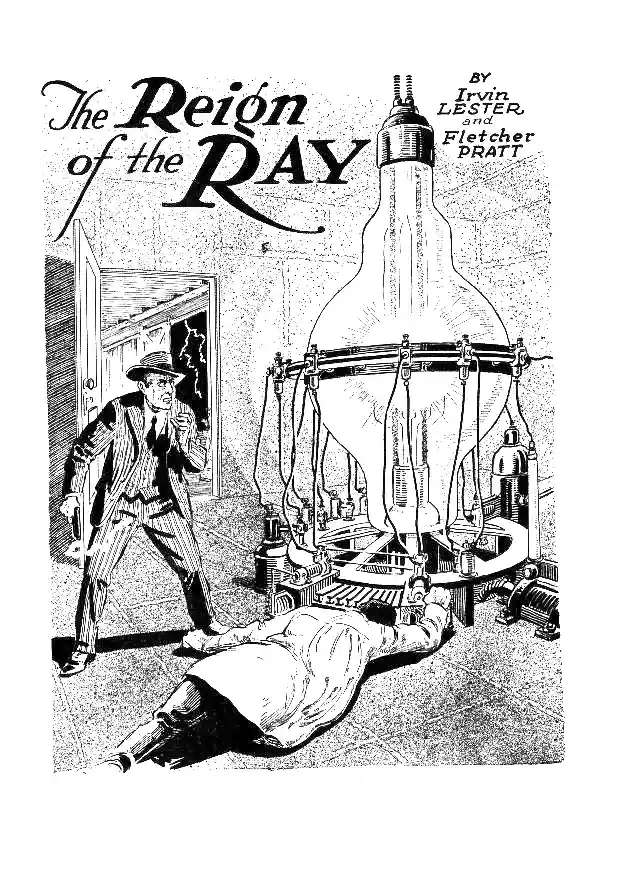
Title: The Reign of The Ray
Author: Fletcher Pratt & Irvin Lester (Irvin Lester was a pseudonym)
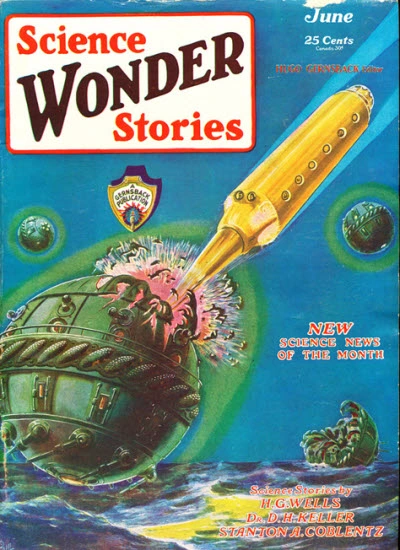
Original Publication: Science Wonder Stories (Vol. 01, No. 1)
Release Date: June 1929
Publisher / Editor: Hugo Gernsback (Stellar Publishing Corporation)
Illustration: Art is not credited
Genre / Subgenres: Pulp Science Fiction / Technological Dystopia / Alternate Warfare / Documentary Fiction
Copyright Status: Public Domain (Free Download Available)
Format & Availability: Article Review + Complete PDF Edition
The complete text of “The Reign of The Ray” and its free PDF version are available at the bottom of this article. Click here to skip to the download section.
“The Reign of The Ray”, written by Irvin Lester and Fletcher Pratt and published in Science Wonder Stories in 1929, presents a chilling vision of technological innovation and its unintended consequences. Lester and Pratt frame the narrative as a historical compilation from the year 2055. So, the tale gains an unusual sense of authenticity for early pulp science fiction while exploring the ambiguous relationship between scientific progress and human conflict.
Plot Summary of "The Reign of The Ray"
Set in the early 20th century, the narrative follows Robert Adams, a reclusive electrical engineer who develops a powerful ray capable of detonating explosives at a distance. When Soviet agents steal his invention, the world plunges into a devastating conflict that transforms the nature of warfare itself.
Spoilers Ahead!!!
Literary & Historical Analysis
Documentary Fiction
Lester and Pratt employ an unusual narrative structure that anticipates documentary fiction. By presenting their story as a historical compilation published in 2055, the authors create a double distance. Readers observe both the original events and a future historian’s interpretation of them. This technique therefore lends an illusion of historical authenticity unusual for 1929 science fiction.
The story’s editorial framing device allows the authors to skip over narrative difficulties while maintaining historical verisimilitude. When detailed records become unavailable, the “editor” acknowledges gaps rather than inventing connective tissue. As a result, this approach lends credibility to the documented portions.
The prose style varies deliberately across different sections. Adams’ diary entries employ terse scientific notation. Epstein’s letter contains colloquial speech patterns and grammatical irregularities. Military reports use a formal bureaucratic language. This stylistic diversity prevents monotony while reinforcing the documentary illusion. However, it also creates pacing challenges, as the narrative voice shifts frequently and sometimes abandons characters for extended periods.
The coded passages in Adams’ diary function as narrative MacGuffins—objects whose specific nature matters less than the pursuit they generate. Like the “Maltese Falcon” or the briefcase in “Pulp Fiction”, the formulas’ actual content remains mysterious. Consequently, they drive the plot without requiring strict technical plausibility.
Post WWI's World
Hugo Gernsback’s magazine helped establish science fiction as a distinct literary genre, moving it beyond simple adventure pulps toward more scientifically grounded speculation. The genre was finding its voice and balancing entertainment with technological extrapolation. Radio, aviation, and electrical appliances were transforming daily life, while memories of the First World War’s mechanised slaughter remained fresh.
The authors write from a world recently introduced to aerial bombardment, poison gas, and tanks; innovations that had made war more impersonal and destructive than ever imagined. Aviation technology occupies an interesting position in the narrative. In 1929, Lindbergh’s transatlantic flight was only two years past, and aircraft were still relatively primitive.
Furthermore, the Soviet Union, established only twelve years before publication, represented an ideological threat to capitalist democracies. The authors’ portrayal of Soviet agents using labour unrest and propaganda to undermine Western governments mirrors the actual Red Scare paranoia of the period, when strikes and protests were frequently attributed to Bolshevik agitation.
About the Author: Irvin Lester and Fletcher Pratt
Fletcher Pratt (Irvin Lester was just Pseudonym) achieved considerable renown as both a science fiction author and military historian. His knowledge of military affairs permeates the story, particularly in the detailed descriptions of tactical innovations and strategic considerations. His historical training manifests in the documentary structure and careful attention to causation. Pratt would later collaborate with L. Sprague de Camp on several well-regarded fantasy novels and establish himself as an authority on naval history.
My Thoughts and Review
Unlike many science fiction narratives that celebrate innovation as inherently beneficial, Lester and Pratt recognise that scientific breakthroughs create new problems even as they solve old ones. The Adams Ray eliminates the threat of explosive weapons, but instead of peace, this invention creates conditions for more brutal warfare. This dialectical understanding—that solutions generate new contradictions—feels remarkably prescient.
The story’s treatment of technological stalemate, where both sides possess weapons that neutralise each other, prefigures the Cold War nuclear standoff narratives. Works like “Fail-Safe“ and “Dr. Strangelove” would later explore similar dynamics with atomic weapons replacing rays.
The isolated scientist-inventor, the stolen technology, the world-shaking discovery, and the arms race all became standard tropes of subsequent science fiction. The documentary framing device, less common at the time, anticipates the mock-historical approach later used by authors such as John Brunner and Kim Stanley Robinson.
The story explores technology’s ambiguous relationship with progress. The Adams Ray promises to end warfare by making weapons obsolete, yet it instead creates conditions for even more destructive conflict. The regression of warfare to medieval conditions literalises this irony. Attempting to move forward through science actually pushes civilisation backward.
Wrapping Up
Lester and Pratt crafted a narrative that transcends expected adventure to explore how technological innovation reshapes warfare, politics, and society. Their documentary structure, while sometimes hampering dramatic momentum, creates unusual depth and authenticity for a 1929 pulp magazine story. Every innovation carries unintended consequences. Every solution creates new challenges. This recognition therefore elevates the story beyond a mere period piece.
The tale captures 1929’s technological optimism and political fears, its faith in science and dread of social upheaval. Yet beneath these period-specific concerns lie timeless questions about innovation’s consequences, isolation’s costs, and the relationship between individual genius and historical forces.
"The Reign of The Ray" PDF Download Free
This work was originally published in 1929 and is in the public domain according to current legislation. However, the original authorship, magazine credits, and any associated illustrations remain the property of their respective creators, illustrators and publishers. This material is provided for informational and educational purposes only and may not be used for commercial sale.
More of Science Wonder Stories

The Making of The Misty Isle – Stanton A. Coblentz (Science Wonder Stories, Vol. 01, No. 1, 1929)
The Reign of the Ray (1929) – Irvin Lester and Fletcher Pratt | Science Wonder Stories
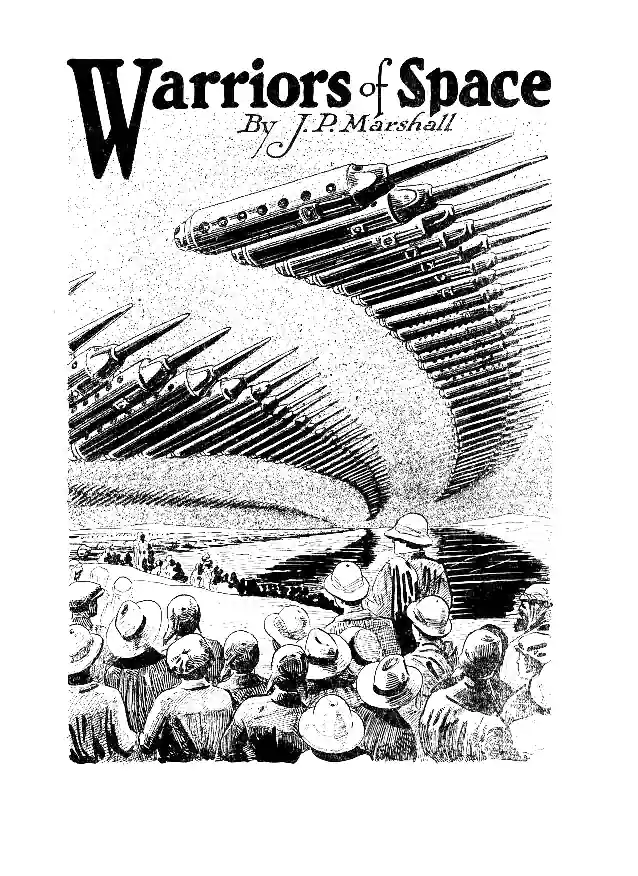
Warriors of Space – James P. Marshall (Science Wonder Stories, Vol. 01, No. 1, 1929)

The Marble Virgin – Kennie McDowd (Science Wonder Stories, Vol. 01, No. 1, 1929)

The Threat of the Robot – David H. Keller (Science Wonder Stories, Vol. 01, No. 1, 1929)