Warriors of Space by J.P. Marshall
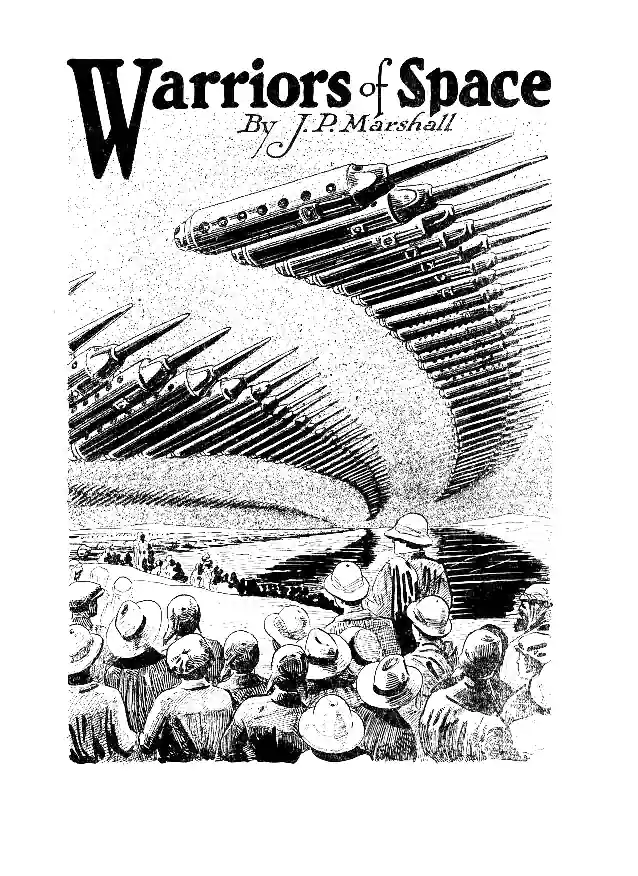
Title: Warriors of Space
Author: J.P. Marshall
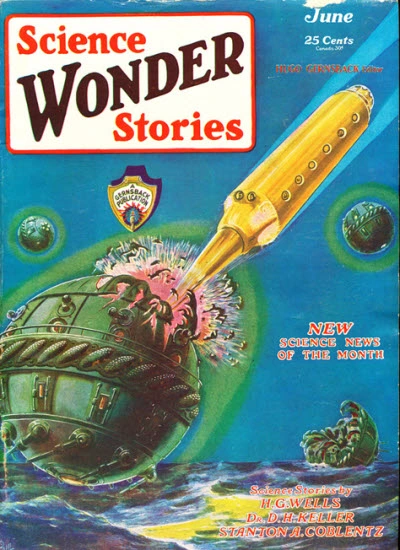
Original Publication: Science Wonder Stories (Vol. 01, No. 1)
Release Date: June 1929
Publisher / Editor: Hugo Gernsback (Stellar Publishing Corporation)
Illustration: Art is not credited
Genre / Subgenres: Pulp Science Fiction / Alien Invasion
Copyright Status: Public Domain (Free Download Available)
Format & Availability: Article Review + Complete PDF Edition
The complete text of “Warriors of Space” and its free PDF version are available at the bottom of this article. Click here to skip to the download section.
“Warriors of Space”, written by James P. Marshall and published in Science Wonder Stories in 1929, delivers one of the earliest examples of full-scale space opera in pulp science fiction. At a time when space travel remained purely theoretical, Marshall imagines an interplanetary war that covers the solar system and reshapes entire worlds(literally). This ambitious story was an example the genre’s growing confidence in the late 1920s, blending scientific speculation with a “cinematic adventure”.
Plot Summary of "Warriors of Space"
“Warriors of Space” tells the story of humanity’s desperate struggle against an alien invasion from Dione, a moon of Saturn. When mysterious green globes threaten Earth with a devastating ray weapon, Professor Arthur Maynard—hero of a similar attack thirty years earlier—and his son Donald must mobilise the world’s resources to fight back. Using revolutionary space cars that manipulate gravity itself, they confront an enemy whose technology seems invincible.
Spoilers Ahead!!!
Space Travel in Golden Cars
Marshall employs a third-person omniscient narrator who can move between characters and locations as needed, though the perspective primarily follows Donald and occasionally his father. This technique allows him to drop scientific explanations and historical background into the flow of the story without relying heavily on dialogue. The prose style remains functional rather than literary, favouring clarity. Marshall writes in the journalistic mode common to pulp fiction, with short sentences, active verbs, minimal description, and a great deal of explanation.
Marshall clearly invested effort in making his gravity-manipulation technology seem plausible to 1929 readers. The space car’s operation through selective amplification and reversal of gravitational forces offered a solution to the propulsion problem, even if it does not withstand the modern physics scrutiny.
Besides that, the story’s treatment of the cosmic consequences takes a curious note. The narrative acknowledges that removing Saturn will disturb Earth’s orbit but treats this disturbance as a temporary inconvenience rather than a potential extinction event. Consequently, the casual acceptance of worldwide devastation—flooded coastlines, destroyed villages, and geographical upheaval—reveals an alarming willingness to sacrifice the present population for future security.
Space travel itself remained just theoretical in 1929. Robert Goddard had launched the first liquid-fuelled rocket only three years earlier, achieving an altitude of just 41 feet. The idea of travelling to Saturn, let alone manipulating planetary orbits, therefore represented the purest speculation.
The narrative structure moves through distinct phases: defence, investigation, planning, execution, and aftermath. The space journey that should form the story’s dramatic centrepiece receives surprisingly brief treatment, condensed into a few pages describing the plan’s execution and success.
A Father and Son Narrative
“Warriors of Space” sits squarely in the space opera tradition that would dominate pulp science fiction through the 1930s and 1940s. The story prioritises large-scale action, interplanetary conflict, strange ships, and a technological spectacle over character development or thematic complexity. The central theme concerns proportionate response to existential threats and how far a civilisation may go to ensure its survival.
Donald’s plan goes far beyond defeating the invaders and destroying their home world. It eliminates their entire planetary system, along with any other inhabitants of Saturn’s moons. The story never questions whether this total annihilation is justified or whether less catastrophic alternatives exist. Basically, the very existence of the threat seems to justify any response, no matter how extreme.
The father-son dynamic between the two Maynards brings a secondary theme: the passing of generations and the evolution of scientific thought. The elder Maynard represents the old guard, an experienced man, somewhat cautious and limited by conventional thinking. Donald, on the other hand, represents youth’s audacity, willing to conceive solutions that older minds would reject as impossible.
The Dionians themselves remain a largely abstract threats. Readers see only their technology and one captured spy, never gaining insight into their culture, organisation, motivations, or psychology. Marshall therefore presents them as straightforward villains whose existence justifies extreme action. This simplification serves the story’s purposes but leaves the ethical complexities of mass destruction unexplored.
Author: James P. Marshall
James P. Marshall is an obscure author in early science fiction history. He appears to have published this single story and one more early tale before disappearing from the genre. Both stories feature Professor Maynard’s character. The professional quality of “Warriors of Space” indicates someone with either writing experience or significant familiarity with scientific romance traditions. Moreover, the story’s ambition and scope hint at an author familiar with the emerging conventions of magazine science fiction.
My Thoughts and Review
Space opera tends toward escapist adventure with carefully managed stakes. Marshall here proposes a literal solar-system re-engineering as a solution to political conflict, then actually follows through on the idea’s consequences.
The story’s casual acceptance of mass destruction troubles me more than Marshall likely intended. The complete absence of moral wrestling over the decision to destroy Saturn and its inhabitants depicts a mindset that views the Other—the alien—as so fundamentally threatening that its total elimination requires no justification beyond capability and need.
The romance between Donald and Louise feels perfunctory. It hits expected beats without developing any chemistry or complexity. Their relationship therefore serves the narrative convenience, giving Donald emotional stakes beyond an abstract duty.
International cooperation receives an equally optimistic treatment. The nations of Earth surrender sovereignty, pool resources, and follow a single strategic vision with barely any friction. This utopian vision ignores the difficulties of coordination, the conflicts of interest, and the challenges of command structure that would plague any such endeavour. As a result, the ease of global mobilisation dates the story more than its technological speculation.
The most obvious comparison here is to H.G. Wells’s “The War of the Worlds” (1898), the template for alien invasion narratives. Wells, writing in the Victorian era, could imagine nature succeeding where technology failed. Marshall, writing in the machine age, cannot conceive victory except through superior machinery.
Wrapping Up
“Warriors of Space” presents an early pulp science fiction at its most audacious and cinematic. James P. Marshall crafted a story that spans the solar system, manipulates fundamental forces, destroys entire worlds, and reshapes Earth itself; all within a relatively brief narrative. The ambition is admirable even when the execution falters. The story moves too quickly, develops characters too thinly, and accepts catastrophic consequences too easily.
It shows an early science fiction’s willingness to imagine radical solutions to fantastic problems.
"Warriors of Space" PDF Download Free
This work was originally published in 1929 and is in the public domain according to current legislation. However, the original authorship, magazine credits, and any associated illustrations remain the property of their respective creators, illustrators and publishers. This material is provided for informational and educational purposes only and may not be used for commercial sale.
More of Science Wonder Stories

The Making of The Misty Isle – Stanton A. Coblentz (Science Wonder Stories, Vol. 01, No. 1, 1929)
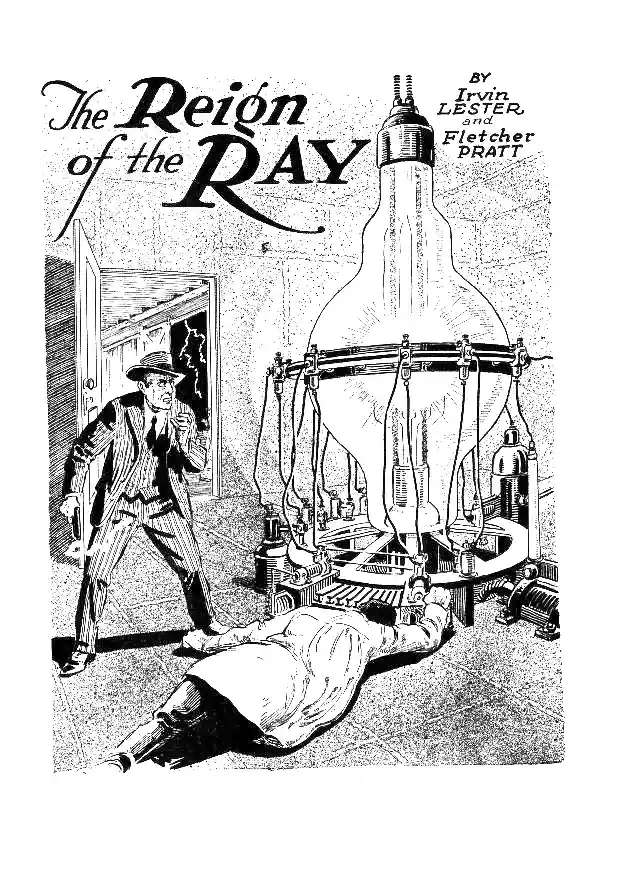
The Reign of the Ray (1929) – Irvin Lester and Fletcher Pratt | Science Wonder Stories
Warriors of Space – James P. Marshall (Science Wonder Stories, Vol. 01, No. 1, 1929)

The Marble Virgin – Kennie McDowd (Science Wonder Stories, Vol. 01, No. 1, 1929)

The Threat of the Robot – David H. Keller (Science Wonder Stories, Vol. 01, No. 1, 1929)