Science Wonder Stories: A Tight Spot for Gernsback
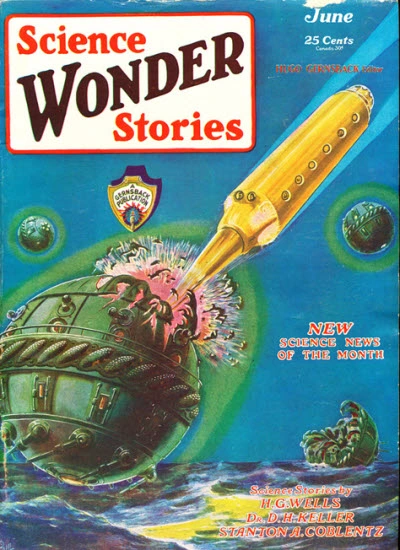
Title: Science Wonder Stories
Issue: Volume 01, Number 01
Release Date: June, 1929
Publisher: Stellar Publishing Corporation
Editor: Hugo Gernsback
Cover Illustration: Frank R. Paul
Genre: Pulp Science-Fiction
Authors: Irvin Lester and Fletcher Pratt / H.G. Wells / James P. Marshall / Kenny McDowd / David H. Keller / Stanton A. Coblentz
Copyright Status: Public Domain
Hugo Gernsback lost Amazing Stories around February 1929. His publishing firm, Experimenter Publishing, had gone bankrupt after being brought down by its own creditors, though the exact circumstances have fuelled speculation ever since. But, he didn’t take long to get back on his feet. By April, he had incorporated a new company—Gernsback Publications Inc.—and set up a subsidiary called Stellar Publishing Corporation. So, he immediately sent out letters to potential subscribers announcing his new magazines.
Readers were asked to vote on the name of the new title. They eventually settled on “Science Wonder Stories”. The June 1929 issue hit the newsagents on 3rd May—less than three months after the bankruptcy declaration. By the time early June rolled around, he had launched a second magazine, Air Wonder Stories, followed by a quarterly companion later that autumn.
Contents of the Issue
The Reign of the Ray - Irvin Lester and Fletcher Pratt
Set in the early 20th century, the narrative follows Robert Adams, a reclusive electrical engineer who develops a powerful ray capable of detonating explosives at a distance. When Soviet agents steal his invention, the world plunges into a devastating conflict that transforms the nature of warfare itself.
The Diamond Maker - H. G. Wells
On a quiet evening along the Thames Embankment, a well-dressed narrator encounters a shabby, desperate stranger who makes an extraordinary claim: he has discovered the secret of manufacturing diamonds. The ragged man produces what appears to be a genuine diamond the size of a thumb and offers to sell it for a hundred pounds. Through their conversation, the stranger reveals his tragic story of scientific obsession, financial ruin, and social isolation.
Warriors of Space - James P. Marshall
“Warriors of Space” tells the story of humanity’s desperate struggle against an alien invasion from Dione, a moon of Saturn. When mysterious green globes threaten Earth with a devastating ray weapon, Professor Arthur Maynard—hero of a similar attack thirty years earlier—and his son Donald must mobilise the world’s resources to fight back. Using revolutionary space cars that manipulate gravity itself, they confront an enemy whose technology seems invincible.
The Marble Virgin - Kenny McDowd
“The Marble Virgin” presents the tragic tale of Wallace Land, a talented young sculptor who falls in love with his own creation—a marble statue he names Naomi. When his neighbour, the brilliant but morally questionable Professor Carl Huxhold, reveals a revolutionary scientific device capable of transforming matter at the atomic level, Wallace witnesses the impossible. His statue comes to life as a flesh-and-blood woman.
The Threat of The Robot - David H. Keller
Ed Ball, a celebrated football player turned explorer, returns to New York after twenty years abroad only to discover a world utterly transformed by technology. Football is now played by robots controlled from keyboards, while millions watch on television screens at home. Stadiums stand empty, human labour faces obsolescence, and society has retreated into isolated entertainment.
The Making of The Misty Isle - Stanton A. Coblentz
Dr. Turnbull, a brilliant engineer, convinces the President, the Secretary, and General Blackfoot that he can trigger a volcanic eruption beneath the Pacific Ocean using a powerful new explosive called “hyperblast”. Their scheme succeeds in raising an island from the sea, which they secretly transform into a military base designed to launch a surprise attack on Japan.
A Educational Science-Fiction
Gernsback had lessons to apply and a point to make. To start with, the format was a clear signal of his intent. The magazine was published in “bedsheet” size (roughly 21 by 30 cm), which was significantly larger than the standard pulp. This choice served as a visual statement to show this wasn’t just some cheap adventure rag. It looked more like a proper journal or an illustrated newspaper supplement. The price was 25 cents, a bit dearer than most pulps of the time.
While Gernsback had previously used the clunky “Scientifiction” in Amazing Stories, he debuted the modern term “Science-Fiction” (initially with a hyphen) in the first editorial of “Science Wonder Stories”. What’s more, “Science News of the Month” occupied multiple pages. Features like “Science Questions and Answers” and “What Is Your Science Knowledge?” positioned the magazine as educational rather than just entertainment with a scientific veneer. Gernsback stated explicitly that teachers encouraged reading the stories because they gave pupils a fundamental grasp of science.
Gernsback was so obsessed with scientific accuracy that he often included a “Science-Fiction Scorecard.” He wanted his writers to be “prophetic.” In fact, one of his most famous—and slightly boastful—claims was that he had predicted radar, television, and neon lights in his own earlier writings.
Frank R. Paul moved with Gernsback from Amazing Stories, as he almost always did. Paul had defined the visual language of science fiction illustration through his years on Amazing. Because of this, he was the natural choice to paint covers for “Science Wonder Stories”, Air Wonder Stories, and every associated quarterly.
Turbulences
“Science Wonder Stories” ran for exactly twelve issues—June 1929 through May 1930—before merging with Air Wonder Stories to become Wonder Stories, which Gernsback published until 1936. It’s worth noting why Air Wonder Stories existed separately at first. Back in 1929, aviation was the “high tech” of the day. Gernsback thought aviation-focused SF was its own massive market, but he quickly realised that readers didn’t want just aeroplanes.
The Wonder group never achieved the commercial success he had hoped for. It debuted just months before the Wall Street crash of October 1929, and the Depression years were a nightmare for magazine publishing. In 1936, Gernsback sold the title to Ned Pines’s Standard Magazines. The new owners relaunched it as Thrilling Wonder Stories, featuring more action, more aliens, and considerably less educational bits and bobs.
Gernsback was notorious among writers for paying very late (or not at all). He was even nicknamed “Hugo the Rat” by some authors. When he launched “Science Wonder Stories”, he actually struggled to get some of the “top tier” pulp writers of the day because his reputation for non-payment followed him from his previous bankruptcy. Still, many today view this as just famous old industry gossip.
Gernsback’s transition to “Science Wonder Stories” represents a change from pioneer to “evangelist.” While Amazing Stories proved there was a market, Science Wonder proved Gernsback wanted to own the culture of science. By creating the Science Fiction League and maintaining the “bedsheet” format, he treated the genre as more than a hobby. He wanted something prestigious, even if his actual business practices were often a bit of a shambles.