Lovecraft Country Book & TV Show: Analysis and Review
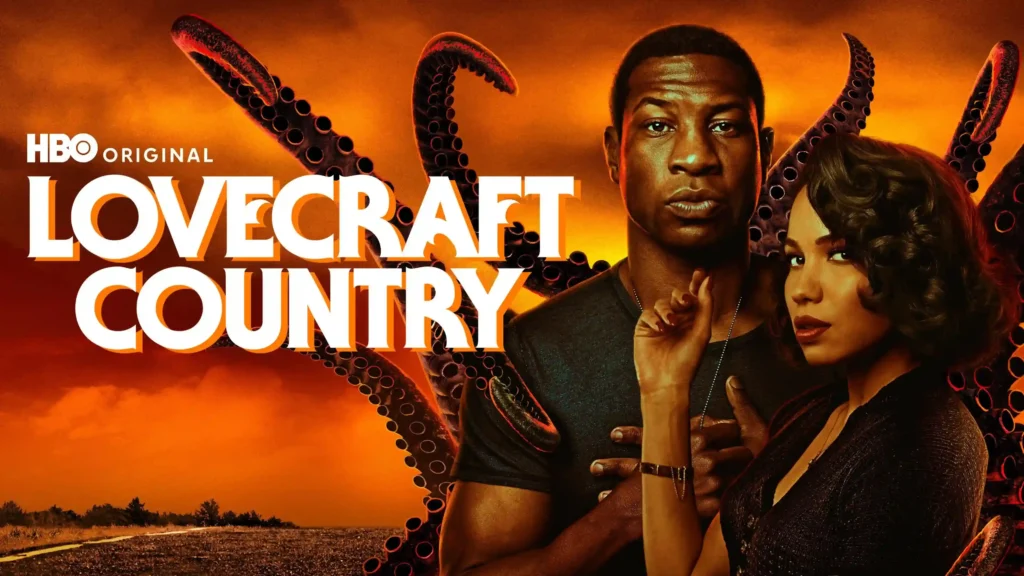
When we think of H.P. Lovecraft, the first image that comes to mind is tentacled monsters, of course, along with the rest of his deities sleeping at the bottom of the ocean and the madness that consumes anyone who dares to stare into the unknown! But despite his massive fame, there is a much more real and terrifying monster that usually stays between the lines of this subgenre: prejudice.
In Lovecraft Country (available as a book by Matt Ruff and adapted into the hit HBO series), cosmic horror gets a more human and social layer. The work takes the established tropes of pulp literature and horror and places them face to face with the reality of racial segregation in the United States during the 1950s.
If you don’t know this story yet or are wondering if it’s worth checking out, here are the main reasons that make Lovecraft Country a proper stroke of genius.
What is Lovecraft Country?
Lovecraft Country is a 2016 dark fantasy and Black horror novel, written by American writer Matt Ruff, later adapted into an HBO TV show(2020).
The story of Lovecraft Country takes place in the 1950s, during the Jim Crow era, and the level of racial segregation is through the roof. Our protagonists, Atticus, his childhood friend Letitia, his uncle George, and his father Montrose live in a reality where being Black is dangerous and travelling along the roads of the United States is a survival mission in hostile territory.
The mad idea presented in the story is the Sundown Towns, and what’s even madder is knowing that this isn’t fiction. Basically, these were towns where the presence of Black people was strictly forbidden after sunset. They couldn’t buy houses, they couldn’t rent rooms in a flat or a hostel, and they were kicked out before the sun went down. Reading it like this, it almost sounds like dystopian science fiction.
The tension of being followed by a racist copper on a deserted road, knowing there are only a few minutes left before sunset and that any “suspicious” move could be fatal, creates an impact worthy of a horror story. In the series, the building of this threat is so suffocating that, when the disfigured literary monsters finally come out of the woods, they almost feel like a relief: against a wild beast you can fight or run, but against state authority and institutionalised violence, the rules of the game are always rigged.
Instead of giving in to madness when facing the inexplicable (as happened to the classic characters in H.P. Lovecraft’s tales), Atticus, Letitia, and Montrose use their resilience, intelligence, and family unity to navigate both dark magic and human oppression.
For more articles about Lovecraft, click here: Is H.P. Lovecraft Overrated?
A Pulp Fiction Format Packed with Genre Variety
Both Matt Ruff’s book and the HBO adaptation use a narrative structure that pays homage to the golden age of pulp stories from the mid-20th century. Instead of following a straight, conventional line with a beginning, middle, and end, the story adopts an episodic, almost anthological format.
Each chapter works like a small, self-contained adventure focused on a different member of the Atticus family (or their close circle), keeping a central arc that ties all the ends together at the finish. As I like anthologies myself, I find this structure brilliant for exploring thematic concepts a bit more. The narrative wanders through classic subgenres of literature and cinema, reconfiguring each one through the lens of the Black experience in the 1950s. You have haunted houses and ghost stories set in a predominantly white neighbourhood. So, she doesn’t just have the ghost to deal with, but she also has to face a hostile neighbourhood ready to do anything to drive her away. Meanwhile, through science fiction and the concept of the multiverse, the story analyses historical trauma that takes on shapes of reflection about the future, the past, and fate (with a clear nod to Afrofuturism).
I don’t know about you, but for me, this diversity creates a constant flow that makes the story fun to explore, with horror built from a specific perspective.
Appropriation and redefinition of H.P. Lovecraft's legacy
It’s no secret to anyone that H.P. Lovecraft was openly racist, and his prejudices are rooted in several of his stories. In his original works, the fear of the unknown, the dread of “miscegenation”, and the idea of marginalised people worshipping nefarious cults were direct or indirect metaphors for his paranoia regarding minorities.
In the traditional Lovecraftian universe, the pattern is usually this: white academics or aristocrats investigate the occult and invariably lose their minds or get destroyed when facing human insignificance in front of the cosmos. Black or non-white people were almost always portrayed as the “strangers” in this equation; linked to cults or to the servitude of madness. Much of this was driven by an extraordinary view of the exotic and different, common in indigenous religions and cultures around the world.
Lovecraft Country makes a move of poetic justice: it takes the universe and visual elements created by Lovecraft, and other authors, and puts Black characters as the active heroes of their own story.
They aren’t helpless victims of cosmic madness; Atticus, for example, is an avid reader of pulp literature and of the horror tales themselves. The cosmic dread that drove the aristocratic protagonists of the past mad doesn’t rattle the heroes of this story in the same way. After all, for someone who already lives under the constant threat of the real, daily horror of segregation, facing an interdimensional entity is just another slightly tougher Tuesday.
Instead of rejecting the aesthetics of cosmic horror because of its creator’s past, the work chose to take ownership of the genre. Elements like the Necronomicon, secret orders of alchemists, tomes in dead languages, and monsters stop being instruments of exclusion and become symbols of this liberation. Putting the family at the centre of this mythology is saying in plain English: science fiction, horror, and the fantastical belong to us too.
Novel vs. HBO Series: Where Should You Start?
Although the HBO series is largely based on Matt Ruff’s book, the two works deliver different experiences, with a few major changes and other minor ones. Start with the book if you like pulp literature, classic science fiction, mysteries, and that feeling of reading genre short stories, but with proper high quality. Now, if you prefer an audiovisual experience, the series is just as brilliant, with a few choices of its own that aren’t in the book and turn out to be great calls. Below, I’ve listed a few differences between both, including the summary of each chapter of the book and each episode of the series.
Spoilers Ahead!!!
Matt Ruff's Lovecraft Country
1- Lovecraft Country
Atticus returns to Chicago after receiving an enigmatic letter from his missing father, who claims to have discovered clues about their family’s origin. Alongside his uncle George and his friend Letitia, he sets off on a road trip towards the isolated town of Ardham, Massachusetts. However, the route reveals dangers ranging from the prejudice and violence of the era to something supernatural, leading the trio to an old manor house inhabited by a cultist society.
2 – Dreams of the Witch House
After inheriting a sum of money from her mother, Letitia buys a massive mansion in a predominantly white neighbourhood in Chicago, determined to turn it into a boarding house. However, the house holds a supernatural presence that seems set on driving out any new resident. While facing the mysteries of the property, Letitia also has to deal with the hostility and racism of the neighbours.
3 – Abdullah’s Book
George and Montrose are forced to accept a dangerous mission to retrieve an ancient occult book hidden deep within a natural history museum, protected by magical barriers. With the help of allies from the Prince Hall Freemasons, they face traps and supernatural challenges in a race against time.
4 – Hippolyta Disturbs the Universe
During a research trip through Wisconsin, Hippolyta explores an old observatory linked to the enigmatic Hiram Winthrop and ends up triggering a hidden mechanism that leads her to an unknown world. There, she discovers traces of experiments and people marked by the Winthrop family’s past.
5 – Jekyll in Hyde Park
Ruby receives a proposition from Caleb Braithwhite: in exchange for a few discreet services, she will get access to magic capable of temporarily transforming her into a white woman. The experience opens doors previously closed to her and reveals privileges and contradictions in the society around her. However, as she goes deeper into Caleb’s plans and the secrets of his magic, Ruby starts questioning the true price of power and how far she is willing to go to get it.
6 – The Narrow House
At Caleb Braithwhite’s request, Atticus and Montrose set off in search of Henry Winthrop, heir to a powerful lineage and possible guardian of ancient occult knowledge. The investigation leads them to a small town marked by a history of racial violence, where traces of the supernatural remain alive.
7 – Horace and the Devil Doll
After catching the attention of the authorities because of a drawing found near the observatory, young Horace finds himself wrapped up in a series of inexplicable events. Unable to ask for help in the conventional way, he needs to find creative ways to escape a supernatural threat that turns ordinary objects into real dangers.
8 – The Mark of Cain
After gathering everything they’ve discovered about Caleb Braithwhite, Atticus, Letitia, George, Montrose, Ruby, and their allies realise they need to act before the conflicts involving magic and power spiral out of control.
HBO's Lovecraft Country
01 – Sundown
After receiving a letter from his missing father, Atticus Freeman sets off on a trip towards isolated Ardham, Massachusetts, accompanied by his uncle George and his friend Leti. However, the trio will have to face the dangers of segregation and supernatural events that pop up in their path.
02 – Whitey’s on the Moon
Upon arriving at the mysterious Ardham Lodge, Atticus discovers that his lineage is tied to a powerful secret society dedicated to the occult arts. While trying to rescue his missing father, he and his companions are dragged into a conspiracy involving a ritual.
03 – Holy Ghost
Leti buys an old mansion in a predominantly white neighbourhood in Chicago, determined to turn it into a home for Black families. However, besides the hostility of the neighbours, she discovers that the house harbours a dark past and a supernatural presence.
04 – A History of Violence
After discovering the location of missing pages from an ancient magic book, Atticus, Leti, and Montrose set off on a risky mission to a museum in Boston. The search for the manuscripts reveals secrets buried for centuries and puts the group face to face with an unexpected witness to the Braithwhite family’s past.
05 – Strange Case
Ruby accepts a tempting offer from Christina Braithwhite that grants her the ability to take on another identity through magic. Living between two realities, she experiences privileges previously out of reach, while getting increasingly wrapped up in the mysterious sorceress’s plans.
06 – Meet Me in Daegu
Ji-Ah is a young South Korean nurse carrying a dreadful supernatural curse, condemned to live between humanity and the spirit world. In the middle of the horrors of the Korean War, her life changes when she meets Atticus, an American soldier with whom she forms an unexpected connection.
07 – I Am
While Atticus follows new clues about the missing Book of Names and discovers unexpected revelations about his own family, Hippolyta returns to the ruins of Ardham in search of answers left behind by George. Her investigation leads her on an extraordinary journey through time and space, where she confronts different versions of herself and discovers potential she never imagined she had.
08 – Jig-a-Bobo
Following a tragedy that shakes her community, Diana is cursed and ends up pursued by a supernatural force as cruel as it is relentless. Isolated and unable to convince the adults of the danger she faces, she has to fight to survive while this mysterious curse threatens to consume her life.
09 – Rewind 1921
Hoping to retrieve an ancient book capable of changing the course of their fight, Atticus, Leti, and Montrose embark on an extraordinary trip into the past, heading to Tulsa in 1921. Right in the middle of one of the most tragic episodes in American history, the group witnesses events that marked their own family and must run against the clock to preserve a legacy that could prove decisive for the future.
10 – Full Circle
In the final showdown against the occult forces threatening their family, Atticus and his allies use the legendary Book of Names to find a way to stop Christina Braithwhite.
Key Differences Between Book and Show
- Uncle George dies at the end of the second episode of the series.
- In the series, the character Horace is swapped for the character Diana.
- In the series, the character Christina takes the place of Samuel Braithwhite. On top of that, in the series, Christina transforms into Samuel, her male version.
- Episodes 1 and 2 of the series are inspired by the first short story in the book.
- Episode 3 is inspired by the second short story in the book.
- Episode 4 is inspired by the third short story in the book.
- Episode 5 is inspired by the fifth short story in the book.
- Episode 6 “Meet Me in Daegu” tells its own original story.
- Episode 7 is inspired by the fourth short story in the book.
- Episode 8 is inspired by the seventh short story in the book.
- Episode 9 is inspired by the sixth short story in the book.
- Episode 10 is inspired by the eighth short story in the book.
Wrapping Up: Is Lovecraft Country Worth Your Time?
Lovecraft Country is an excellent horror and science fiction story, and in the case of the series, it packs a great script, top-notch acting, and great visual effects; it is an HBO series after all. It’s a sharp reflection on who has the right to tell stories and on generational trauma, adding new elements to Weird Horror while showing the strength of a community when facing nonsense. It’s a work that rewrites the rules of one of the most traditional genres in literature, works from an engaging perspective, plays around with pulp tropes, and manages to be well-written and proper fun throughout.
The TV series has enough of its own elements to be well worth a watch beyond the book, carrying extra weight in its social commentary. However, it does feature a fair few adult scenes, so exercise discretion. As for the book, the decision to go with an episodic format—as if every chapter were an issue of a 1950s pulp magazine—makes the reading completely addictive.