The Thing From Another World (1951) Review: The Sci-Fi Classic That Inspired John Carpenter's The Thing
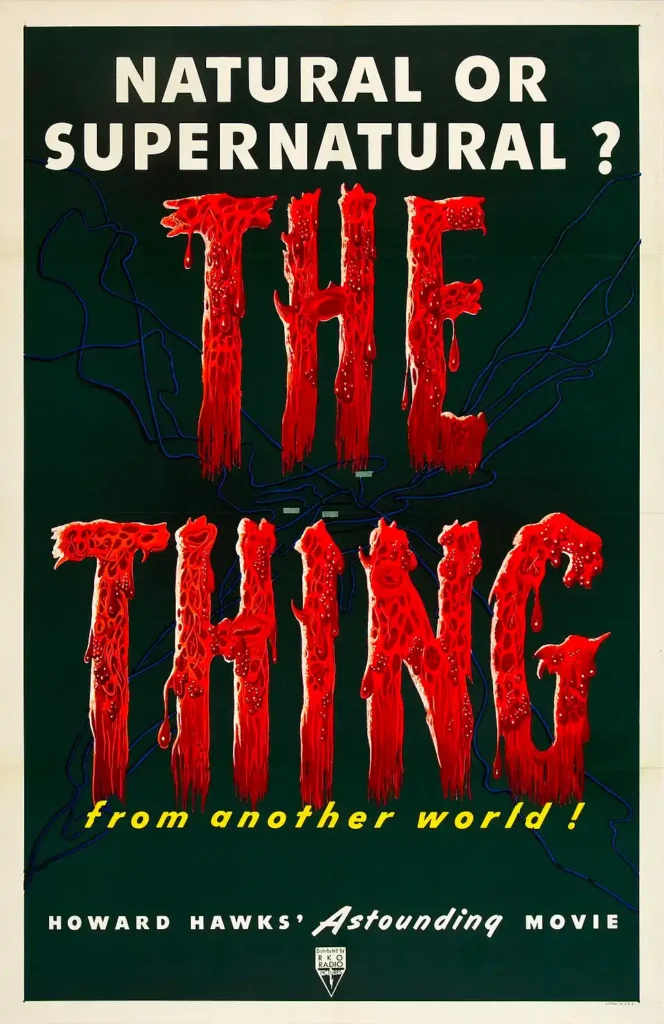
Title: The Thing From Another World
Director: Christian Nyby
Screenplay: Charles Lederer
Production: Edward Lasker, Howard Hawks
Distribution: RKO Radio Pictures
Release Date: April, 1951
Runtime: 87 minutes
Cast: Margaret Sheridan, Kenneth Tobey, Robert Cornthwaite, James Arness, Douglas Spencer, James Young, Dewey Martin, Robert Nichols
Genre: Sci-Fi, Horror
Based On: “Who Goes There?” by John Campbell Jr.
Long before body horror and CGI monsters took over the screen, “The Thing From Another World” set the definitive gold standard for cinematic alien encounters. Released in 1951 during the height of the post-war years and directed by Christian Nyby, this science-fiction horror classic laid the groundwork for an entire genre. Like me, you probably found your way to this film through “John Carpenter’s The Thing”. Even though they are based on the same novella, “Who Goes There?” by John W. Campbell Jr., they are very different films.
To understand why, let’s look at the story, the cinematography, and the biggest differences between the two adaptations.
The Plot of "The Thing From Another World"
The story follows a group of hard-nosed US Air Force crewmen and a handful of dedicated scientists stationed at a bleak, freezing and isolated research base near the North Pole. Before long, the team discovers what appears to be a spacecraft buried beneath the ice. They manage to excavate the pilot, frozen solid inside a block of ice, and transport him back to the cramped confines of the base.
You can probably guess what happens next.
Spoilers Ahead!!!
The Monster of the Arctic
“The Thing From Another World” is a fairly slow film. It takes roughly 17 minutes before the crew discovers the mysterious spacecraft, and almost 50 minutes before the creature is thawed out and begins threatening the people at the station.
As you would expect from 1950s science fiction, there is a lengthy sequence devoted to scientific explanations and discoveries. These moments help justify the story while giving it an air of scientific plausibility.
It almost feels as though this section exists to hook the audience with the idea of, “Look at these incredible and frightening scientific possibilities.” During this time, we also get to know the characters as they go about their duties and debate what should be done while waiting for instructions from their superiors.
Is that a complaint? Not really. It’s an excellent introduction with a likeable cast. What keeps these opening scenes engaging is the growing conflict between the military personnel, who focus on safety and practical decisions, and the scientists, who see the discovery as an extraordinary opportunity for scientific progress, even if it involves taking serious risks.
Then comes what feels like the second half of the film: the creature awakens.
From this point onwards, the story becomes one of isolated people trying to survive while being hunted by a monster. The creature itself has plant-like characteristics, forcing the group to devise ways of protecting themselves while setting traps to destroy it. In practice, it’s essentially a giant Frankenstein-like brute, incredibly resilient and almost impossible to stop.
Another aspect worth mentioning is the sheer number of characters. There are plenty of military personnel, a journalist and several scientists. Considering how much time the film spends introducing them, it might have been more satisfying if more of them had fallen victim to the creature’s attacks. To be fair, one character does die, but that’s about it.
That is not something the film absolutely needed. Still, after spending so much time with these people and waiting so long for the monster to appear, it feels like a natural expectation.
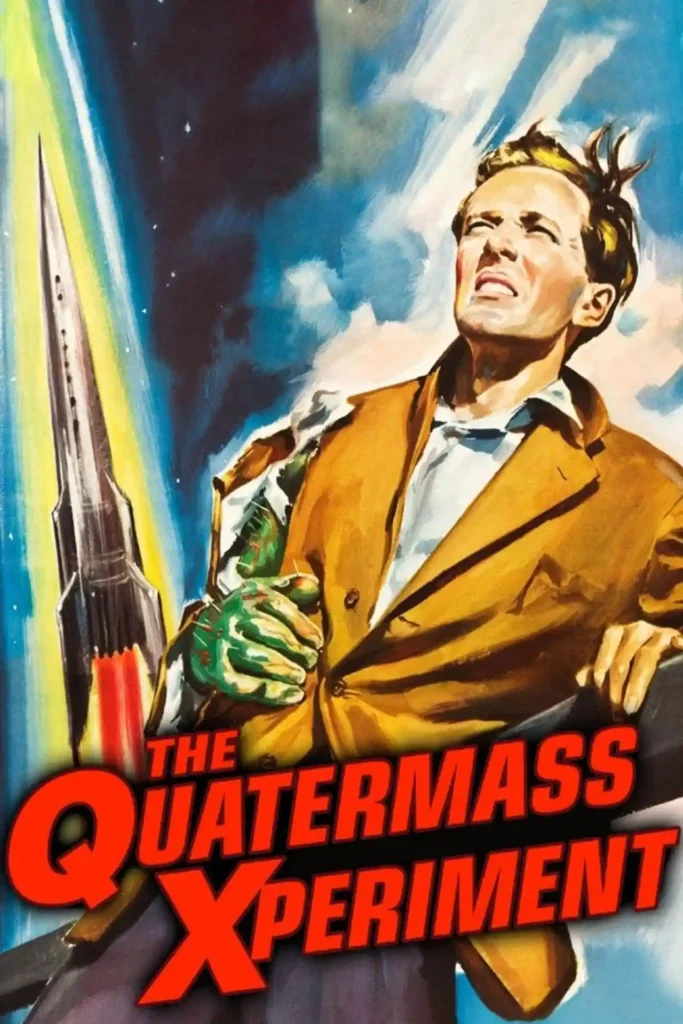
More Film Review: The Quatermass Xperiment (1955)
Cinematography and Production Design
The production design is one of the film’s greatest strengths. The Arctic setting really gives you some chills. The exterior scenes are almost permanently covered in brilliant white snow, something the black-and-white photography enhances beautifully. At the same time, the constant sound of icy winds creates an uneasy atmosphere that only fades once the characters step inside the station.
The interiors, by comparison, feel welcoming and comfortable.
The cinematography was handled by Russell Harlan, a six-time Academy Award nominee well known for his collaborations with Howard Hawks. Most dialogue scenes, whether in the radio room, the canteen, the laboratory or the sleeping quarters, use clean, straightforward key lighting. High contrast and heavy shadows only appear during scenes featuring the creature or moments of suspense.
Characters in The Thing From Another World
With such a large cast, the cinematography frequently frames four to six characters within the same shot as they move together through the set.
This highlights one of the greatest qualities of classic cinema. Dialogue scenes are rarely interrupted by constant editing. The camera is allowed to follow the actors as they deliver their lines instead of cutting between faces every couple of seconds. It’s wonderful to watch.
The film also makes use of overlapping dialogue. Instead of politely waiting for one actor to finish speaking, the characters interrupt one another or talk over each other, just as people do in real life.
The performances are easily one of the film’s biggest attractions. Every actor delivers calm, highly professional performances with impressively natural speech.
Kenneth Tobey leads the cast with effortless confidence and charm. He plays the dependable military hero, while the soldiers under his command remain loyal to their captain and carry out every order without hesitation.
Margaret Sheridan plays Tobey’s romantic interest, bringing plenty of witty banter and playful exchanges to their scenes.
Robert Cornthwaite portrays Dr Carrington, an elegant scientist who speaks with measured authority and unwavering intellectual conviction.
The monster is played by James Arness. Since the make-up was relatively simple and the production wanted to avoid making the creature look like a ridiculous walking plant, Arness relied on his imposing height, well over two metres tall, to create a purely physical threat.
The Monster Design
The creature’s design can be divisive. Personally, I think it still looks fantastic and remains highly memorable. That said, it’s unmistakably a Universal-style Frankenstein monster.
The make-up is excellent, and Arness’s towering frame allows the creature to fill an entire doorway whenever it appears, creating an imposing image. One of the film’s finest sequences comes when the creature is set ablaze with burning oil as it enters the soldiers’ quarters. Even today, it’s difficult to imagine how they filmed that scene without someone getting hurt.
For most of its limited screen time, the monster is either standing still or slowly advancing towards its victims. Even so, it remains incredibly cool.
The Thing From Another World (1951) vs. The Thing (1982)
The key point of comparison comes from the source material. While both films are based on “Who Goes There?” by John W. Campbell Jr., they focus on completely different aspects of the novella.
The Monster: Frankenstein Creature vs Molecular Parasite
The 1951 monster, played by James Arness, is a humanoid, plant-like creature that feeds on blood. It’s an obvious external threat, physically imposing and capable of smashing through almost anything standing in its way.
Carpenter returned to the novella’s original concept. His alien assimilates, imitates and consumes human cells before walking unnoticed among the crew while disguised as one of them.
Group Unity vs Total Paranoia
Reflecting post-war American optimism, the 1951 film celebrates teamwork. The soldiers and scientists, apart from Dr Carrington, trust one another. They joke together, discuss strategies, listen to each other’s opinions and function as a united group. It captures that optimistic belief that humanity is entering a future filled with incredible discoveries, but dangerous with no control.
Carpenter’s film takes the opposite direction. Isolation and fear destroy every trace of trust. Nobody believes anyone else. The famous blood test becomes the high point because the humanity of every character is constantly questioned.
Triumph and Warning vs Ambiguity
The original film ends with humanity victorious. The group devises a smart electrical trap and destroys the creature. The closing message celebrates survival while delivering its unforgettable warning:
“Keep watching the skies!”
Carpenter’s ending could not be more different.
The station has been destroyed. Almost everyone is dead. MacReady (Kurt Russell) and Childs (Keith David) sit in the freezing snow waiting to die, with neither man knowing whether the other is still human.
Carpenter’s version is also far more claustrophobic and far more horror-focused than the 1951 film. Ironically, it is also much closer to Campbell’s novella. “The Thing From Another World” uses the source material mainly as inspiration for its setting and opening premise instead of attempting a faithful adaptation.
Is The Thing From Another World Worth Watching?
“The Thing From Another World” captures a quality that was common throughout the 1950s, turning its science-fiction story into a warning about the future. Given that it arrived only a few years after the atomic bomb, that approach makes perfect sense.
That didn’t win everyone over. Some critics felt it drifted too far from the original novella and became another epic monster film.
Even so, it remains a wonderfully produced thriller with outstanding performances and black-and-white cinematography that has lost none of its appeal. It earned its legendary reputation fairly, proving that great filmmaking never grows old.
So, if you have never watched this milestone of 1950s science fiction, do yourself a favour. Turn off the lights, settle in comfortably and revisit where it all began.
“Tell the world. Tell this to everybody, wherever they are. Watch the skies, everywhere! Keep looking. Keep watching the skies!”