Atomic New Age

The Impersonators: Bureaucracy and Unions on the Farthest Planets

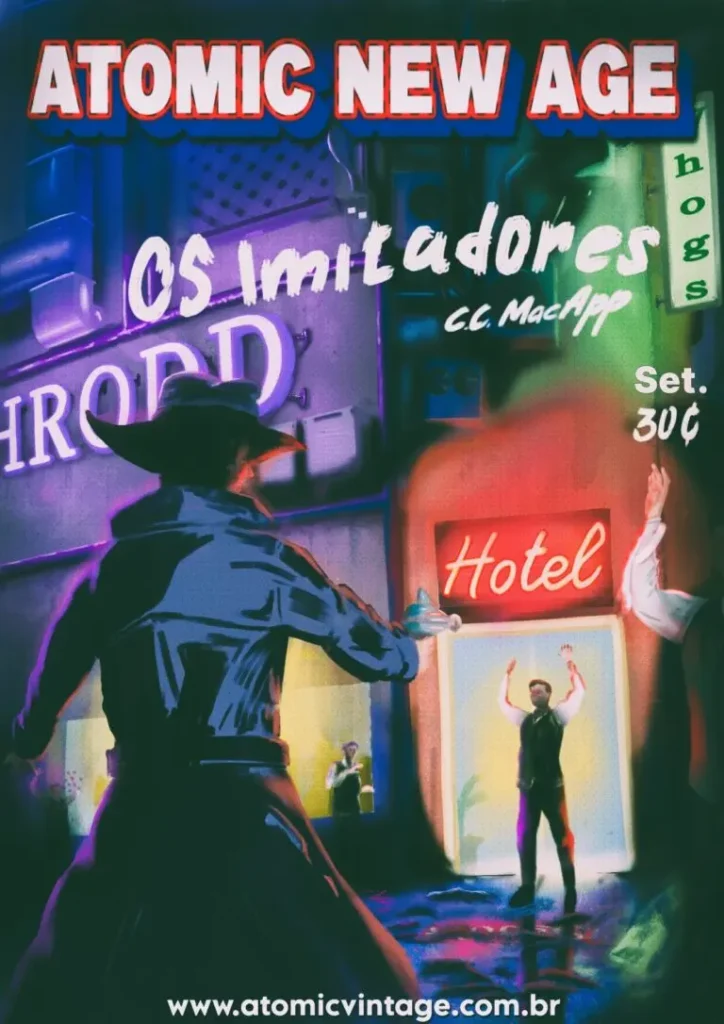
The Impersonators is a science fiction comedy short story by the writer Carroll Mather Capps, writing as C.C. MacApp, published in 1967 in the magazine Worlds of If vol.17 n.1. The story stands out because it brings a science fiction tale with eccentric aliens in a noir plot loaded with humour.

The complete PDF of this public domain edition is available for download at the end of this article.

The Impersonators

Plot Summary of "The Impersonators"

In the distant future, humanity already travels between stars and maintains diplomatic relations with alien empires. Inspector Judson Kruger, a detective from the Interstellar Division of the Earth Government, is sent to the planet Phrodd to arrest a runaway accountant called Borogrove O’Larch, who embezzled a million and a half credits. The problem is that Phrodd is inhabited by the Whugs, an alien race with a perfect ability for imitation, and the criminal did not take long to use them to his advantage.

Spoilers Ahead!!!

Comedy of Errors

The big point in The Impersonators is how the absurdity escalates very fast in the story. Kruger has an almost impossible goal in his hands and there are no excuses. However, the institutions, instead of solving the problem, seem stuck by bureaucratic processes. The plot happens in an environment full of regulations and protocols. Kruger needs to solve the problem, but he knows that, to do this, he will not be able to follow the rules. He embodies the typical policeman who does not mind getting his hands dirty to do his duty.

Even to phone his boss, his call needs to go through a department, then reach the assistant, and only then reach his boss. And what is the solution that Kruger finds? He decides to do exactly what he was explicitly forbidden from doing.

Despite being forbidden from making certain decisions, Kruger feels that the urgency of the situation justifies his actions. Consequently, his willingness to act outside the norms matches the central theme of the story. The bureaucracy becomes the real antagonist.

It is a classic model of a comedy of errors moved into science fiction, where the exotic serves only to amplify typically human problems.

The prose is direct, full of action and almost without literary ornaments; which is, actually, a virtue here. The humour depends on timing, and the author masters the timing of the short sentence and the absurd detail placed in the right spot.

The Problem is the Bureaucracy

The story was published in Worlds of If in 1967, at the height of the late Golden Age of American science fiction. And this context is relevant: the 1960s saw a significant change in the tone of mass science fiction, with many authors embracing pessimism, irony, comedy and satire as an alternative to the technological optimism of the previous decades. The authors left aside a bit the concept that technology could be used for good and for bad, depending only on who used it, and started to write about a reality where man one way or another loses control of this technology; or discovery, or social condition and so on.

Vietnam, the Cold War and the growing distrust in government institutions created a fertile soil for stories about incompetent bureaucracy, institutional waste and the absurdity of formal systems, and all this due to countless demonstrations of mistakes by these institutions. So ended the concept that the nice government will use technology in a way to help humanity and its citizens.

The Interstellar Division of Kruger is clearly a satirical extrapolation of the American federal agencies of the time — with their tight budget, inept bosses, forms and “treaties and protocols and codes of honour and everything you have ever heard of.” MacApp does not need to name his target; any reader from 1967 recognised the type.

Author: C. C. MacApp

C. C. MacApp was the pseudonym of Carroll M. Capps (1917–1971), an American writer who published almost exclusively in pulp science fiction magazines during the 1960s. MacApp was an engineer by profession and a writer by late vocation, and because of this he does not have a collection of stories as large as his companions of the era.

He is almost completely forgotten today, which is a moderate injustice. His best short stories combine imagination with a dry and well-calibrated sense of humour, as well as social criticisms of the system.

My Thoughts

I like the plot of The Impersonators because it is clever and funny and takes science fiction down different paths. The short story resists the temptation to be cleverer than it needs to be. MacApp could have turned the Whugs into a heavy metaphor about identity or the Grugs into an allegory of race and marginalisation. Instead, he uses them to build a well-executed farce and then stops at the right point.

There is something refreshing about this. Not every science fiction story needs to change your worldview. Sometimes it is enough to create a plausible universe, put an exhausted man trying to do his job inside a system that sabotages him.

This work was originally published in 1967 and is in the public domain according to current legislation. However, the original authorship, magazine credits, and any associated illustrations remain the property of their respective creators, illustrators and publishers. This material is provided for informational and educational purposes only and may not be used for commercial sale.

Body Snatcher

The Body Snatcher – Robert Louis Stevenson

Robert Louis Stevenson's Gothic Chiller Robert Louis Stevenson truly cemented his name in Victorian literature, both with rousing adventures like ...
/
The Supernumerary Corpse

The Supernumerary Corpse – Clark Ashton Smith | Vengeance and the Unknowable

The Supernumerary Corpse – Science and Weird Fiction Analysis “The Supernumerary Corpse” by Clark Ashton Smith (1932) is a disturbing ...
/
Let's Get Together

Let’s Get Together – Isaac Asimov | Cold War Science Fiction, Paranoia and the Ethics of Technology

Isaac Asimov’s Let’s Get Together: Cold War Suspense and Ethical Dilemmas We are in the heart of the Cold War—though ...
/
The Drug

The Drug by C. C. MacApp – A Sci-Fi Thriller Exploring The Human Transformation

Introduction What happens when a single discovery shatters the boundaries of human potential—and sanity? In The Drug, 1961, C. C ...
/
The Eye of Apollo

The Eye of Apollo by G.K. Chesterton — An Inquiry into Blindness

Introduction G.K. Chesterton’s The Eye of Apollo, first published in The Saturday Evening Post in 1911, features his astute character, ...
/
Double Cosmos

Double Cosmos: the terror of the double and the expansion of the mind according to Clark Ashton Smith

A Journey Through Parallel Realities "Double Cosmos" represents an overlooked entry in Clark Ashton Smith's extensive catalogue of weird fiction ...
/
Scroll to Top