Forbidden Planet (1956) Review: The Golden Age Sci-Fi Movie
Title: Forbidden Planet
Director: Fred M. Wilcox
Screenplay: Cyril Hume
Production: Nicholas Nayfack
Distribution: Metro-Goldwyn-Mayer
Release Date: March, 1956
Runtime: 98 minutes
Cast: Walter Pidgeon, Leslie Nielsen, Anne Francis, Warren Stevens, Jack Kelly, Richard Anderson, Early Hollimman
Genre: Sci-Fi
Story By: Irving Block / Allen Adler
We’re here to talk about a true science-fiction classic, the famous “Forbidden Planet”, an MGM production directed by Fred M. Wilcox and released in 1956. To really understand why this film has remained such a favourite, we first need to jump back to the world of 1950s cinema.
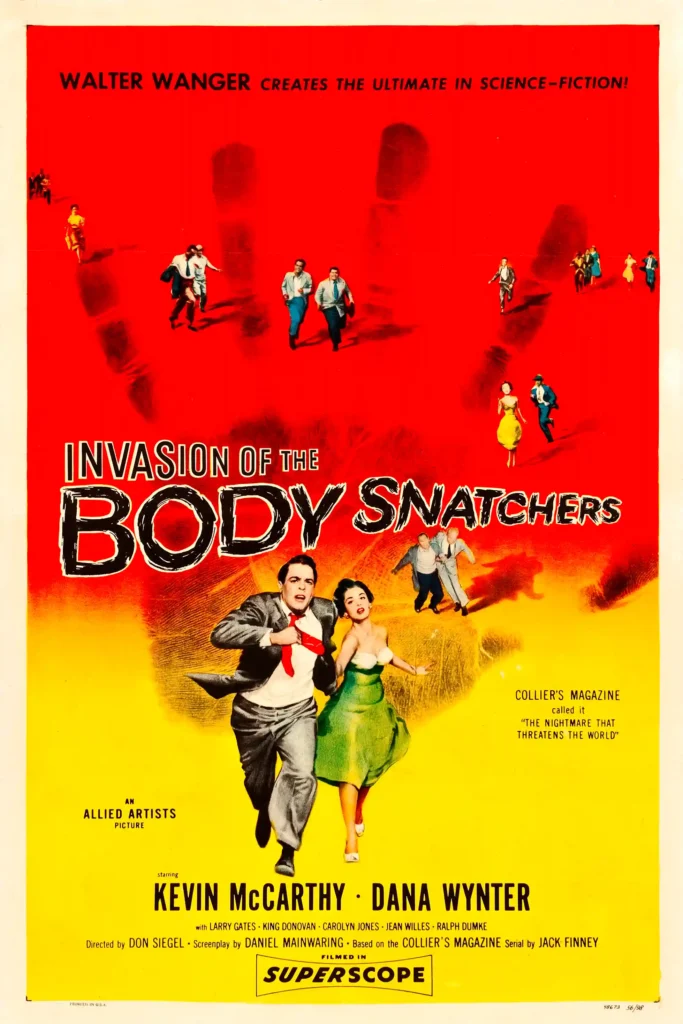
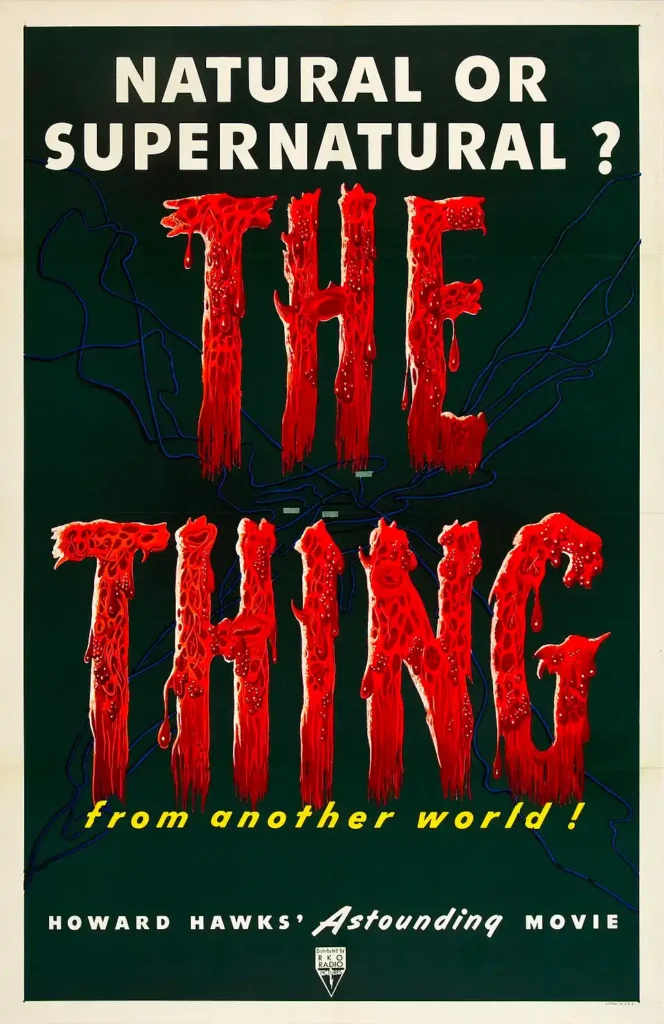
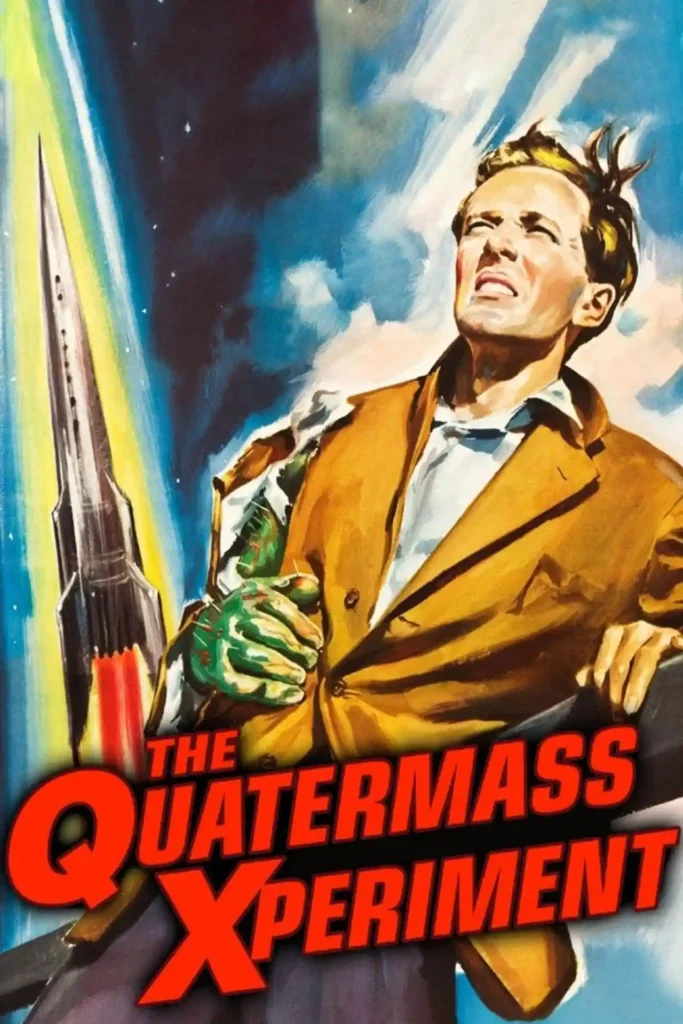
Science fiction took quite a while to gain recognition as a “serious” genre. For years, it was largely confined to B-movies shown at drive-ins, packed with rubber-suited aliens, giant mutated insects, stiff robots and paper-thin atomic allegories. Much like horror at the time, the genre was treated by the major Hollywood studios as low-budget entertainment for matinee audiences. And, to be fair, most of those films really were rubbish.
That’s where Metro-Goldwyn-Mayer and its famous lion changed everything with “Forbidden Planet”. By investing an impressive budget of nearly two million dollars, shooting in the wide-screen CinemaScope format and presenting a colourful sci-fi adventure, not dazzling by today’s standards but colourful enough for its time, MGM gave space exploration a level of credibility that cinema had rarely seen before.
Even the opening of the film is impressive when you remember it came out in 1956. From the very first scene, you can tell this wasn’t a cheap production.
It isn’t an exaggeration to call it one of the biggest turning points in science-fiction cinema. To understand why, let’s take a look at my thoughts on the film and what I made of it
The Plot of “Forbidden Planet"
The story takes place in the 23rd century aboard the starship C-57D, commanded by the stoic Commander John J. Adams (Leslie Nielsen). Their mission is to travel to the distant world of Altair IV and investigate the fate of the Bellerophon, an expedition ship that vanished twenty years earlier. When they arrive, the crew discovers only two human survivors: the philologist Dr Edward Morbius (Walter Pidgeon) and his daughter, Altaira (Anne Francis).
Review: Crafting an Alien World
Direction & Screenplay
Overall, “Forbidden Planet” is a restrained mystery, with a touch of romance as well. Fred M. Wilcox’s direction is simple and straightforward, placing a great deal of trust in the production design at his disposal. That approach helps maintain a constant sense of mystery and uncertainty, which keeps most of our attention fixed on what’s happening on screen.
What does that mean in practice? Most of the time, the camera remains still within a large set while the characters move around it. The downside is that the film feels confined, with the cast travelling between only a handful of locations. That’s typical of 1950s cinema, but you do miss a greater sense of scale or freedom within this world, or planet.
The screenplay strikes a good balance between philosophical ideas and pseudo-scientific concepts, explaining its bigger ideas through dialogue that is perfectly watchable. There’s none of the painfully long-winded exposition that can drag these films down, but it also avoids the paper-thin conversations that were common in many pulp magazine stories.
Freud in Space: The Id, the Ego, and Human Limits
“Forbidden Planet” explores a theme, and introduces a creature, that remains incredibly interesting even today. It’s the kind of idea that deserves a modern adaptation or fresh reinterpretation.
According to the film’s backstory, Altair IV was once home to the Krell, an extraordinarily advanced civilisation that built a machine capable of turning thought into matter. Yet, despite all their knowledge, the Krell vanished overnight.
Their fatal mistake was forgetting that the mind contains an ancient, unconscious shadow. When they activated their planet-wide machine, the collective “Monster from the Id” of their entire civilisation was unleashed at once, wiping them out in a single night.
The same thing happens to Morbius.
After expanding his mind through Krell technology, he unknowingly opens a doorway to the darkest parts of his own unconscious. In doing so, he creates a creature born from his suppressed anger, his intellectual jealousy and his overprotective feelings towards his daughter, Altaira
Characters and Robby the Robot
The characters themselves are genuinely enjoyable, giving us the familiar spacefaring soldiers alongside an ambitious, obsessive scientist.
Leslie Nielsen plays Commander John J. Adams. Yes, that Leslie Nielsen. I only recognised him because I saw his name in the credits, otherwise I never would have guessed. He looks completely different from the actor most people remember from “The Naked Gun”. Here, Nielsen plays a pragmatic officer and the classic space commander.
Walter Pidgeon plays Dr Edward Morbius, a proud yet tragic scientist slowly consumed by his work. What he discovered, along with everything that happened in the past, drives him to protect his research at any cost.
Altaira (Anne Francis) is certainly the second biggest reason to stay invested in what’s happening, after the central mystery (if you know what I mean). Her story follows a journey from innocence, shaped by a lifetime of isolation, towards self-discovery.
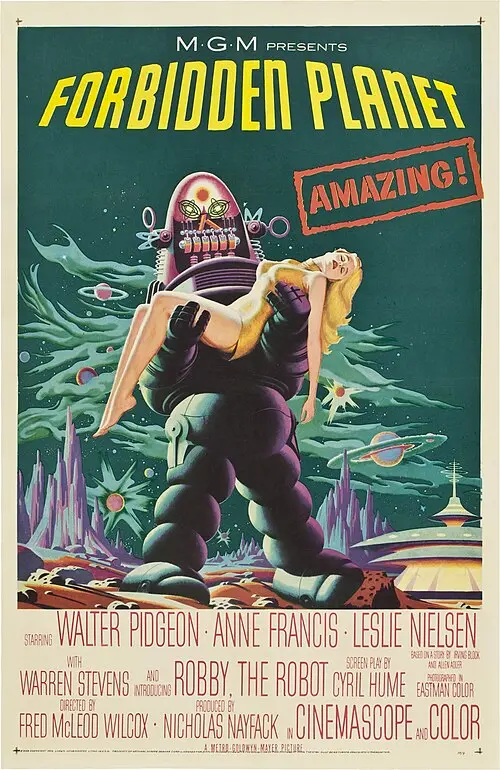
And then there’s the film’s greatest star: Robby the Robot, who reportedly cost around $120,000 to build, an astonishing amount for the time. Designed by MGM’s Robert Kinoshita, Robby has a wonderfully playful appearance, complete with a transparent “brain” full of spinning gears. I honestly feel sorry for whoever had to wear that suit. Judging by Robby’s stiff movements, it couldn’t have been comfortable.
Robby is also considered one of the first robots in cinema to have a genuine personality and an important role in the story. He occupies a surprising amount of screen time, interacts constantly with the other characters and has plenty of dialogue. Considering how much he cost to build, MGM clearly intended to get its money’s worth.
Some Writing Issues
There’s one thing about the screenplay that always makes me laugh, though, and it appeared quite often in Golden Age science fiction: the completely unearned romance.
Back in the 1950s, a romantic subplot seemed almost like a studio requirement for any big-budget production. There was this fixed idea that every hero had to win the girl before the final act. Since “Forbidden Planet” already had to explain complicated ideas, fit in action scenes and justify plenty of screen time for the very expensive Robby, the romance was clearly rushed.
Altaira has spent her entire life in isolation with only her father and Robby for company. The script uses that as an excuse to explain why she falls for the first young, handsome man she meets. Commander Adams spends the first half of the film acting like a stern father figure, criticising Altaira’s clothes and behaviour, and then, almost without warning, they’re kissing beside a lake. I’m not exaggerating. That’s exactly what happens.
Cinematography
Visual Aesthetics & Eastmancolor Cinematography
Visually, “Forbidden Planet” was an average experience for me. As I’ve mentioned in some reviews, there’s something about black-and-white cinematography that ages incredibly well, and it’s still my favourite look.
Don’t get me wrong, the film is visually impressive, but colour also makes its limitations easier to spot. Since I don’t think the lighting is especially memorable, it loses a little of the appeal that black and white might have given it. Add a fairly neutral colour palette and the image can feel slightly washed out.
The production follows a classic high-key lighting approach, using bright, even illumination so everything remains visible across the CinemaScope frame. The downside is that many scenes appear a little flat.
Even so, that style helps create an imaginative setting, particularly with the green skies of Altair IV. It also gives the film that unmistakable vintage sci-fi look, reinforcing the planet’s sense of isolation and sterility. Every scene set on the planet was filmed entirely inside a studio. That’s quite incredible, and it certainly explains why the environments feel so controlled and enclosed throughout the film.
The special effects, however, are very good. The opening sequence, with the spacecraft travelling through space, has a very Star Trek feel. The enormous underground complex showcasing the vast technology of the Krell is another highlight, while the scene where the invisible monster briefly appears as it’s struck by electrical fire is simply brilliant, and easily the best visual moment in the film.
To create the visual effects for the Id Monster when it becomes visible within the electric force field, MGM hired veteran Walt Disney animator Joshua Meador. Drawing frame-by-frame animatics over live-action footage, Meador created the fiery, roaring energy monster that is the best scene of the movie.
Unfortunately, I can’t say the same about the ray guns. Their laser effects are functional at best.
The film also has an interesting piece of cinema history behind its sound design. It featured the first entirely electronic film score in cinematic history, composed by Louis and Bebe Barron.
Does Forbidden Planet Hold Up Today?
Seven decades… Seven decades, after its theatrical release, “Forbidden Planet” is a towering triumph of Golden Age cinema. While certain gender dynamics and theatrical acting styles clearly reflect its 1950s origins, the film’s main elements have lost none of their power.
The film was a commercial and critical success, and the American Film Institute later named it one of the ten greatest science-fiction films ever made. More importantly, “Forbidden Planet” helped shape an entire generation of productions through its visual style, storytelling and conceptual approach to prestige science fiction.
Its clearest legacy can be seen in “Star Trek”. Gene Roddenberry openly acknowledged that “Forbidden Planet” was one of the primary inspirations behind his iconic universe. Beyond “Star Trek”, Robby the Robot’s design also helped pave the way for famous sci-fi droids such as R2-D2 and C-3PO in “Star Wars”.
So yes, I think that’s a pretty impressive achievement, and I’d say “Forbidden Planet” has more than earned the reputation we talked about at the beginning of this review.
Frequently Asked Questions (FAQ)
Is Forbidden Planet based on Shakespeare's The Tempest?
Yes. Forbidden Planet is widely recognized as a loose adaptation of William Shakespeare’s play The Tempest. The film translates key characters and themes into a sci-fi setting: Dr Morbius is Prospero, Altaira represents Miranda, Robby the Robot acts as Ariel, and the Monster from the Id takes the place of Caliban.