Invasion of The Body Snatchers (1956) Review
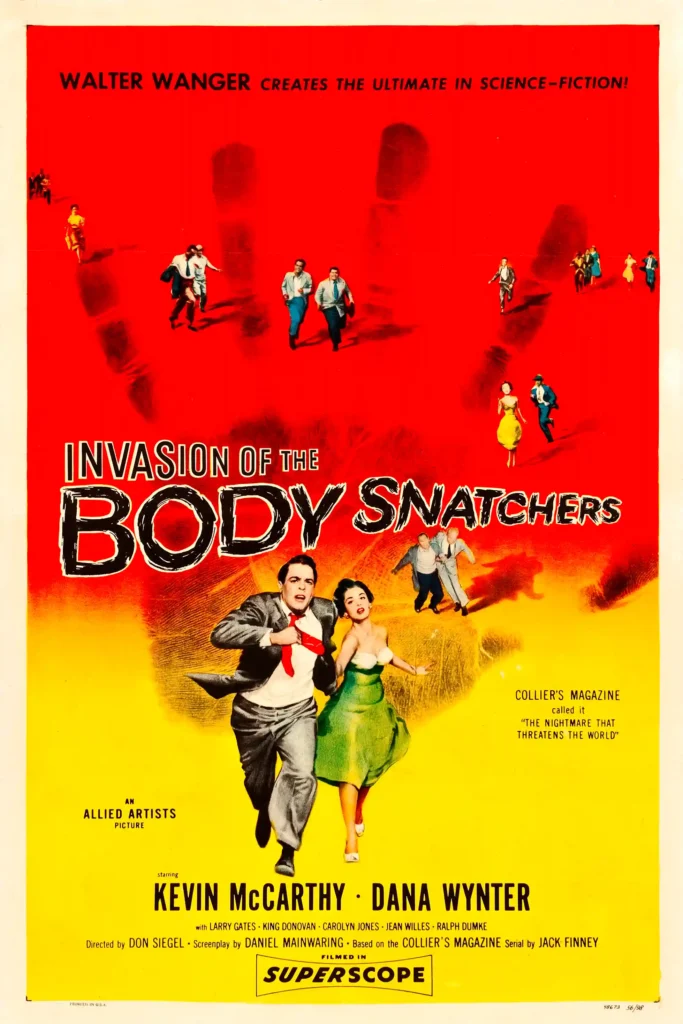
Title: Invasion of The Body Snatchers
Director: Don Siegel
Screenplay: Daniel Mainwaring
Production: Walter Wanger (Walter Wanger Productions)
Distribution: Allied Artists Pictures
Release Date: February, 1956
Runtime: 80 minutes
Cast: Kevin McCarthy, Dana Wynter, Larry Gates, King Donovan, Carolyn Jones, Jean Willes, Ralph Dumke
Genre: Sci-Fi
Based on: “The Body Snatchers” by Jack Finney
“Invasion of The Body Snatchers” is a sci-fi film, considered a B-movie, directed by Don Siegel and released in 1956. The story is adapted from John Finney’s serialised novel “The Body Snatchers”. I would like to start by saying that “Invasion of The Body Snatchers” is a very good film and well above average, leaving you with that feeling that you wish you had seen more. It has an extraordinary concept, along with excellent direction, production and acting.
Now, to see this more clearly, let’s take a look at what makes this film such an excellent piece of sci-fi.
Plot of "Invasion of The Body Snatchers"
The story is told as a flashback by general practitioner Dr Miles Bennell (Kevin McCarthy), who returns from a medical convention to find his quiet, ordinary town suffering from a psychological phenomenon. Patient after patient reports that their family members no longer seem to be the same people, at least not in essence.
Invasion of The Body Snatchers' Impressions
Honestly, I expected the film to be at least decent, but I didn’t expect to have so much fun watching it. I imagined it would be a bit more goofy or campy, but it is the opposite, with a gripping narrative and an incredible film noir tension.
The film hooks you from the beginning with this sort of prologue, where we find a completely distraught and neurotic Dr Miles. Nobody believes his story, and we start to consider that it might be nothing more than madness inside the doctor’s mind. Then we are taken to a quiet Californian setting where everything seems normal, which already raises our suspicions that something is wrong.
The film gradually builds the suspense, spending the first 20 to 40 minutes on setup. You slowly realise that the phenomenon is spreading throughout the town, while the doctor’s attempts to deal with this strangeness make him look like a lunatic, as if nothing is actually wrong. I love this. It is my favourite part of the story: the character is alone and paranoid, seeing what nobody else can see, knowing there is something going on behind the scenes while everyone around him acts normally. It reminds me a lot of the “Nightmare at 20,000 Feet” episode of The Twilight Zone.
The second part of the story, once the problem and its nature have been established, gives the film a darker survival tone. The characters are surrounded, nowhere is safe, and they have no idea how far the changes have spread. This eventually leads to a huge chase, with the entire town already replaced by the aliens.
Cinematography
“Invasion of The Body Snatchers” begins with a brighter image and that Californian summer atmosphere of the 1950s. The quiet town is well lit, with citizens going about their business in an immaculate and spacious production designed to portray an ordinary town in the American West. However, the film gradually adopts a darker composition as the problem grows. A large part of the second half takes place at night, when things are being taken over.
One of the best compositions in the film comes when they find the first body. We have a very dark object in the foreground, while Dr Miles, also wearing a black suit, occupies part of the screen. Further back, other characters are illuminated. It may sound silly, but it is this sort of thing that leaves a positive impression on you moment after moment.
When we reach the final act, the lighting becomes bright again and the sunny environment returns, creating the feeling of a new normal. Except this time, the entire town has already been replaced by the aliens. This is the new normal, the new and peaceful Santa Mira.
Screenplay
The screenplay is not far behind in terms of quality, although it’s simple and has nothing extraordinary about it. It didn’t need to at that point in cinema history. The beginning already hints at something extraordinary with this sort of prologue, where the doctor, like a madman, tries to convince the doctors and the police of his unbelievable story.
It was a wise decision because, from there, the real beginning develops slowly. Perhaps, if the film had started directly, it could have lost the attention of impatient viewers. It has nothing particularly absurd to present straight away, and the overall experience depends on this slow introduction.
Now, despite that, I would have liked to see more moments and interactions between the humans and the aliens, and the film is a little conservative in this regard. That also ends up being interesting because these beings remain mysterious from beginning to end. What I mean is that I would have liked to see more scenes and more possibilities explored in the screenplay.
I have to admit that the final chase is nail-biting. I was already worried about our main couple and disturbed by the thought of a situation like that. It begins intelligently, with them trying to disguise themselves as one of the pod people. Of course, the disguise doesn’t last very long, so they run through the desert mountains of California, trying to reach the motorway with an army of people chasing them.
Then comes the final ordeal, which takes place inside a cave. There, the protagonist, the doctor, has to decide whether he will keep running or surrender to the invaders.
McCarthyism
Considering that the film is a product of the 1950s, it is clear that it has a subtext connected to the reality of the Cold War. Nothing too explicit on the surface, but you can dig into it and find little things here and there. First, we have the classic warning against a Red invasion, the famous “Red Scare” propaganda. The pod people represent a collective mind where individuality and self-expression disappear in favour of absolute conformity. In this way, the ideology takes over American suburbs until we are surrounded by it.
At the same time, it seems to be a criticism of McCarthyism itself. McCarthyism was a campaign of political persecution in the United States between the late 1940s and the 1950s. Led by Senator Joseph McCarthy, the movement created a “witch hunt” against people suspected of communism, resulting in censorship, dismissals and arrests without solid evidence. In other words, there was an atmosphere of suspicion that encouraged citizens to report their neighbours. The pod people could represent those who surrender themselves to this kind of unified regime.
Regardless of the interpretation, what the film makes clear is that joining the pod people means giving up who you are. However, this is not presented as entirely negative, since according to the invaders themselves, they are not affected by human suffering, and everyone who changes claims that they are right. This is distressing and tempting because you want to know what exists on the other side. We see the characters becoming increasingly exhausted, to the point of giving themselves up, as if they were one step away from some kind of paradise.
You can also notice a certain erosion of truth within the plot, where one character knows that something around them is wrong but nobody believes him and everyone says otherwise. And so, everyone gathers around the lie, filled with promises, while some survive in paranoia, being swallowed and crushed by the mass.
Is Invasion of The Body Snatchers Really That Good?
Honestly, I thought I was going to like the film, but the truth is that I loved it more than I expected and it certainly lives up to its reputation. I even find it strange that this film is considered B-movie cinema. The production is excellent, the screenplay is excellent, the actors are excellent too, and you finish the film with the feeling that you want to know a little more about what is happening.