Atomic New Age

The Call of Cthulhu by H.P. Lovecraft: Free PDF & Review

6 min read | Free PDF Included

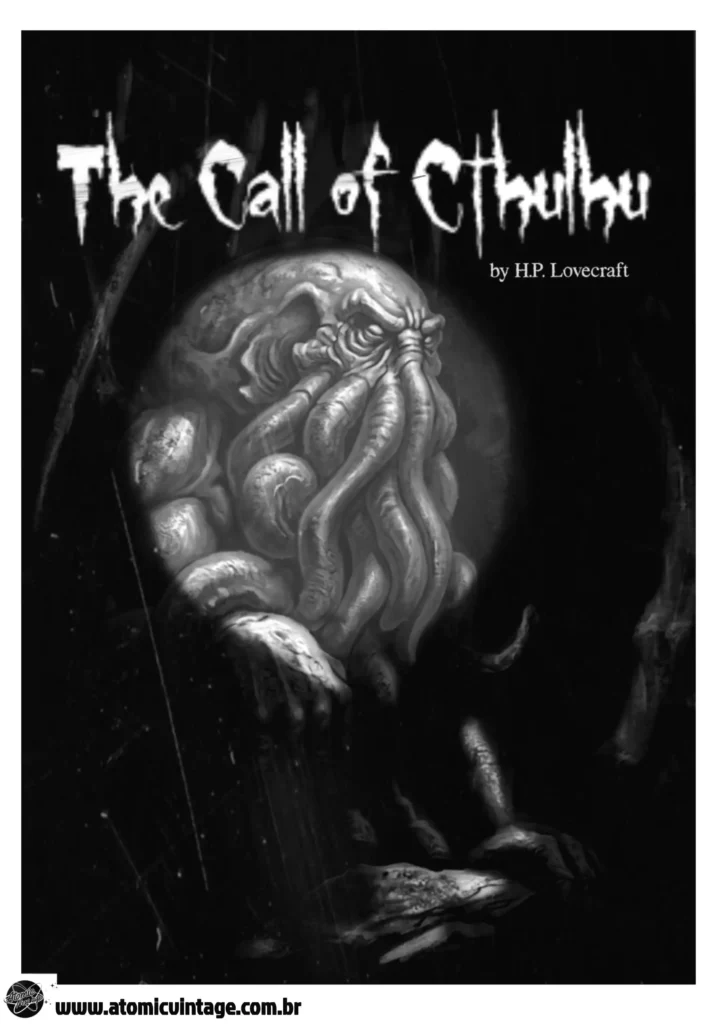
Cover of The Call of Cthulhu by H.P. Lovecraft, depicting the Cthulhu


Title: The Call of Cthulhu 


Author: H.P. Lovecraft 


Original Publication: Weird Tales (Vol. 11, No. 2)


Release Date: February 1928


Publisher / Editor: Farnsworth Wright (Popular Fiction Publishing Company)


Illustration: Yan Viana


Genre / Subgenres: Horror / Cosmic Horror / Weird Fiction 


Copyright Status: Public Domain (Free Download Available)


Format & Availability: Article Review + Complete PDF Edition


The complete text of “The Call of Cthulhu” and its free PDF version are available at the bottom of this article. Click here to skip to the download section.


“The Call of Cthulhu” is H.P. Lovecraft’s most famous short story, and perhaps the most famous story in the entire mythology created by the author and his fellow writers of Cosmic Horror. The story was written around 1926, but was only published in 1928 in Weird Tales Magazine, Vol. 11, No. 2, where Lovecraft introduced the world to the creature that won readers over and became the most popular figure in his pantheon of oddities: Cthulhu.

Plot of "The Call of Cthulhu"

After the mysterious death of his great-uncle, a respected professor of Semitic languages, a man inherits a box of private documents that the deceased had kept secret. Among the papers, he finds a strange clay bas-relief sculpted by a young artist tormented by recurring dreams of strange cities and a voice coming from the depths. As he investigates the origin of these records, the narrator discovers that his uncle had spent decades gathering evidence of a secret cult spread across every continent, a cult that worships a sleeping entity beneath the oceans, waiting for the moment when “the stars are aligned” to awaken.

The Narrative Structure of "The Call of Cthulhu"

“The Call of Cthulhu” has a fairly comfortable structure for Lovecraft, with a “manuscript within a manuscript” (a document within a document, or an account within an account), you get the idea. This allows the author to avoid directly describing the elements of the setting or the creatures themselves, with the descriptions being mediated through the narrator. This way, he keeps the narration believable while withholding information to build suspense.

There is a certain epistemological distance where the reader never sees or hears anything directly, and instead receives everything through curious fragments.

The text has the author’s typical archaic and cumulative style, using plenty of adverbs and adjectives, with long sentences that attempt to describe the feeling of the indescribable or the sense of awe. The narrator repeatedly states throughout the story that he has no words for what he has seen, admitting human inadequacy in the face of such grandeur.

In this story, Lovecraft makes extensive use of dates, coordinates and geographical coincidences as a pseudo-scientific framework of evidence, lending a degree of documentary plausibility to the supernatural events.

Complete H.P. Lovecraft List of Stories by Releasing Date

Characters and Settings

Francis Wayland Thurston: A Boston anthropologist and the nephew of George Gammell Angell (his name only appears in the story’s subtitle in the original Weird Tales version).

Professor George Gammell Angell: Professor of Semitic Languages at Brown University, Providence.

Sculptor Henry Anthony Wilcox: An art student who sculpted a bas-relief of Cthulhu based on the strange dreams he was having.

Inspector John Legrasse: A New Orleans police officer who led a raid on a Cthulhu cult in the bayou.

Gustaf Johansen: A Norwegian sailor who left behind records describing the discovery of R’lyeh and his encounter with Cthulhu.

Castro: An elderly mixed-race man who claims to have spoken with leaders of the Cthulhu cult.

William Channing Webb: A professor of Anthropology at Princeton University who was familiar with the idol of the octopus-headed god.

Cthulhu: Mainly described through his statue. He has a vaguely humanoid form, but with an octopus-like head, while his face is a mass of tentacles and appendages. His body is scaly and “rubber-like”, with enormous claws on his fore and hind legs, and long, narrow wings on his back.

R’lyeh: R’lyeh is the sunken city where Cthulhu dwells and lies asleep. It is described as geometrically strange, with non-Euclidean shapes and spherical forms. It is colossal in size and affected by changes in perspective. According to the information provided by the author, R’lyeh lies in the South Pacific.

My Thoughts and Review

“The Call of Cthulhu” is not my favourite story by the author. I think he leans a little too heavily into the “technical” or pseudo-scientific descriptions, which can make things a bit boring at times. Let’s say he spends three quarters of the story building evidence before we actually get anything happening. This makes the short story feel as though it drags on unnecessarily.

So, considering the author’s entire body of work, for me, this is somewhere in the top 10, but near the bottom of the list, you know? I have much more fun with other stories, whether they are longer or shorter, before “The Call of Cthulhu”.

The story’s greatest achievement is that it almost single-handedly created a grammar of horror that became a standard within the genre. Its release was a success with Weird Tales readers and among the circle of writers surrounding the Mythos.

Contemporary Authors of Lovecraft You Need to Know

Wrapping Up

“The Call of Cthulhu” is unquestionably a foundational text of what we now call Cosmic Horror or Lovecraftian Horror, a subgenre that influenced later horror literature, cinema and a whole range of role-playing games. Although it is not the author’s best story, it remains effective and grand in what it sets out to do, serving as an example of the kind of terror so often praised by the author.

"The Call of Cthulhu" PDF Download Free

This work was originally published in 1928 and is in the public domain according to current legislation. However, the original authorship, magazine credits, and any associated illustrations remain the property of their respective creators, illustrators and publishers. This material is provided for informational and educational purposes only and may not be used for commercial sale.

Cover of The Call of Cthulhu by H.P. Lovecraft, depicting the Cthulhu

The Call of Cthulhu – H.P. Lovecraft | Review & PDF

The Call of Cthulhu by H.P. Lovecraft: Free PDF & Review 6 min read | Free PDF Included  Title: The ...
/
Body Snatcher

The Body Snatcher – Robert Louis Stevenson

Robert Louis Stevenson's Gothic Chiller Robert Louis Stevenson truly cemented his name in Victorian literature, both with rousing adventures like ...
/
The Supernumerary Corpse

The Supernumerary Corpse – Clark Ashton Smith | Vengeance and the Unknowable

The Supernumerary Corpse – Science and Weird Fiction Analysis “The Supernumerary Corpse” by Clark Ashton Smith (1932) is a disturbing ...
/
Let's Get Together

Let’s Get Together – Isaac Asimov | Cold War Science Fiction, Paranoia and the Ethics of Technology

Isaac Asimov’s Let’s Get Together: Cold War Suspense and Ethical Dilemmas We are in the heart of the Cold War—though ...
/
The Drug

The Drug by C. C. MacApp – A Sci-Fi Thriller Exploring The Human Transformation

Introduction What happens when a single discovery shatters the boundaries of human potential—and sanity? In The Drug, 1961, C. C ...
/
The Eye of Apollo

The Eye of Apollo by G.K. Chesterton — An Inquiry into Blindness

Introduction G.K. Chesterton’s The Eye of Apollo, first published in The Saturday Evening Post in 1911, features his astute character, ...
/
Double Cosmos

Double Cosmos: the terror of the double and the expansion of the mind according to Clark Ashton Smith

A Journey Through Parallel Realities "Double Cosmos" represents an overlooked entry in Clark Ashton Smith's extensive catalogue of weird fiction ...
/
Grito de um planeta distante

Cry From A Far Planet by Tom Godwin: expansion and communication

Introdução Imagine standing before the unknown. What would you do? How far would you go in the name of progress? ...
/
The Defenders

The Defenders of Philip K. Dick: An Analysis of the Future, Technology, and Reality

Philip K. Dick’s paranoia How much control does war have over mankind? Philip K. Dick is well known for his ...
/
Scroll to Top